Roughly 95% of venture capital jobs still get filled through a warm introduction, not a job board.
That statistic explains almost everything about why venture capital feels closed off to outsiders. It is not that firms are hiding open roles. It is that most firms never post them, because a partner's network already produces enough qualified candidates to fill the seat.
The workaround is not to manufacture a network out of thin air. It is to join a program that was built specifically to hand you one, along with the deal-sourcing reps, the memo-writing practice, and the partner-level mentor that a cold application can never replicate.
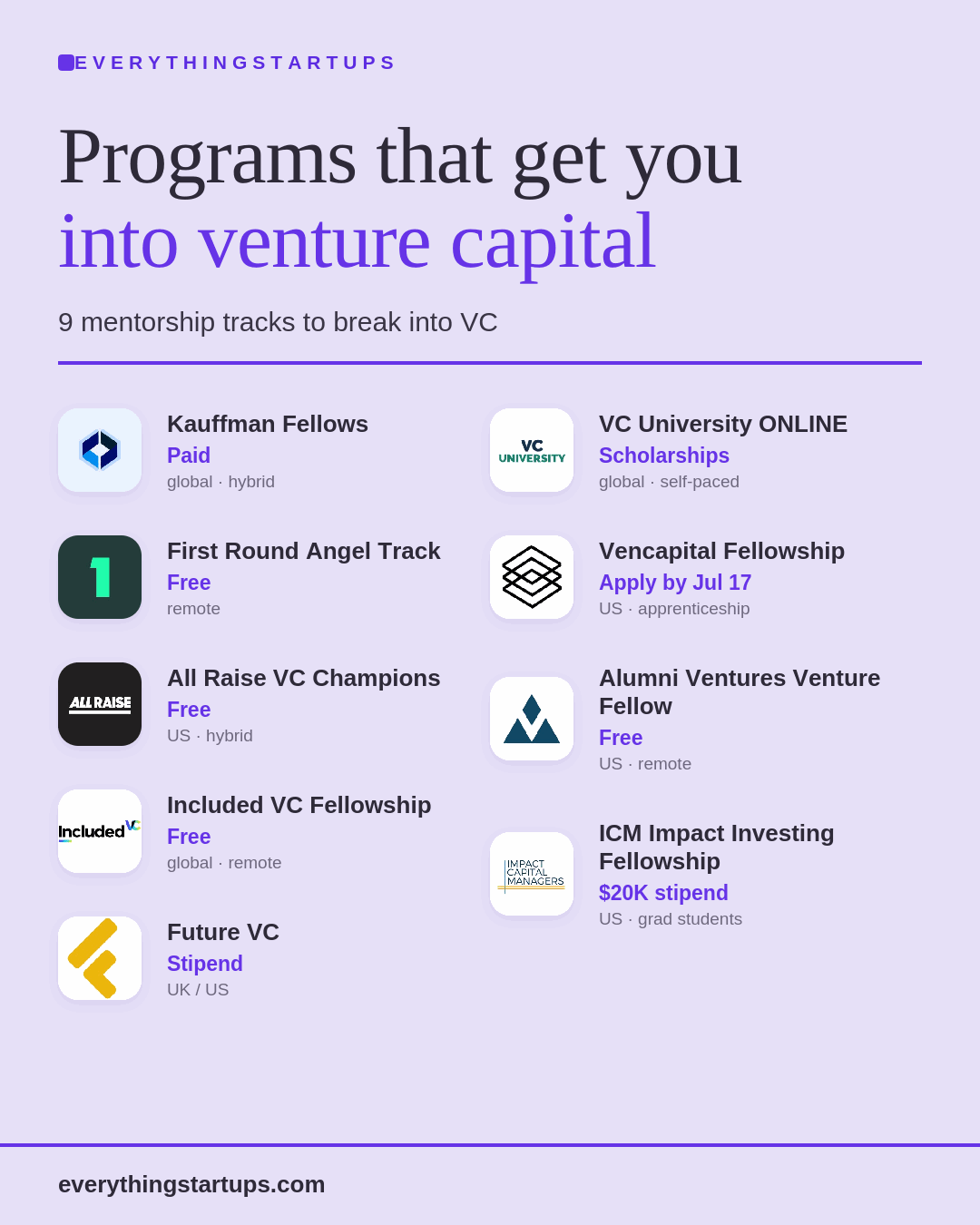
We pulled together the nine mentorship programs founders and aspiring investors mention most often when this question comes up, what each one actually costs you in time or money, and the exact steps to apply to each.
Why a Warm Intro Still Decides Most VC Hires
Venture firms are small on purpose. A typical early-stage fund runs with two to six investing partners and no dedicated recruiting function, so a hire is almost always sourced through someone a partner already trusts.
That structure rewards people who are already inside the room and quietly filters out everyone who is not, regardless of how sharp their thinking is.
Mentorship programs exist to break that loop. A program that pairs you directly with a general partner, puts you inside a cohort of other aspiring investors, and has you sourcing and diligencing real deals gives you the exact track record a cold resume cannot show.
By the time you finish, you are no longer a stranger applying into the industry. You are someone a partner has already watched work.
What a VC Mentorship Program Actually Gives You
Before comparing programs, it helps to know what you are actually signing up for, because the format varies more than the marketing pages suggest.
Most programs combine three things in different proportions: structured curriculum on how investing actually works, hands-on deal experience where you source or evaluate real companies, and a mentor relationship with someone who has sat on the other side of hundreds of pitch meetings.
Compensation ranges widely. Some programs are entirely unpaid and sell you on the network and the credential. Others pay a stipend in the low thousands per month.
A small number, like Kauffman Fellows, actually charge tuition, because the value proposition at that level is not entry into the industry but acceleration once you are already in it.
Time commitment matters just as much as cost. A program asking for 5 hours a week fits around a full-time job. One asking for a full-time summer does not. Match the format to your actual life before you fall in love with a brand name.
The 9 Best VC Mentorship Programs Right Now
1. Kauffman Fellows
Kauffman is the program partners at brand-name firms cite on their own bios, and it is built for people who are already investing rather than people trying to break in.
The two-year curriculum pairs a global cohort with senior mentors across multi-day summits covering thesis development, portfolio construction, and firm leadership.
Fellows also join a monthly Forum, a small group of six or seven peers who meet for confidential, self-directed coaching, and every fellow gets an assigned or self-sourced mentor before the second module.
The scale of the alumni network is the real draw. Kauffman counts roughly 900 alumni managing over a trillion dollars in AUM, and internal data shows one in five unicorns worldwide has a Kauffman Fellow somewhere in the cap table.
Tuition runs $80,000 over two years, typically covered by the fellow's firm, with need-based scholarships available through the KF Fund and corporate partners that can cut the cost by up to half for candidates who broaden the cohort's diversity.
How to apply:
Submit the written application, which covers your deal track record, references, and motivation for joining. If you clear that stage, you move to a 45-minute interview with two alumni, then a partner-level panel that calibrates the incoming class across geography, background, and asset class.
The early deadline for the next cohort is December 12 with a $100 fee, and the final deadline is January 9 with a $300 fee. Acceptance historically sits around 6-8%, so apply early and lean on a current fellow or sponsoring firm for a reference if you have one.
2. First Round Angel Track
Angel Track is First Round Capital's answer to a specific problem: operators and founders who have started angel investing on their own but have no structured way to get better at it fast.
The program is three months of evening sessions where First Round partners walk through sourcing, pricing, and post-investment support, built around an in-person retreat that brings the cohort together for a few focused days.
It costs nothing and provides no capital. What it provides instead is admission to a 400-plus person alumni community that includes people like Instacart's Max Mullen and Figma's Jenny Wen, and a Slack that keeps circulating live deals and questions long after the formal sessions end.
How to apply:
You do not need to be accredited to join, only to invest once you start, and ideal candidates already have some operational background and a handful of angel checks under their belt.
Around 35-40 fellows are selected per cycle to keep the discussions genuinely interactive, so line up two founders who can vouch for you before you submit, and be specific in your application about the kind of companies you want to back.
Dates for the next cohort are announced on First Round's site closer to the program start.
3. All Raise VC Champions
VC Champions is narrower than most programs on this list by design. It pairs principal-level women and non-binary investors with two general partner "Champions" for monthly one-on-one guidance over roughly six months, focused specifically on the mechanics of the path to partner rather than on breaking into the industry from scratch.
Because it sits inside a larger nonprofit, Champions members also get access to All Raise's broader VC Cohorts, tight-knit peer groups of investors at the same career stage who meet monthly to compare notes on deal flow, fundraising, and firm dynamics.
How to apply:
All Raise runs its Champions and Cohorts intake through its site, and eligibility is scoped to women and non-binary investors already working at the principal level or equivalent.
If the cost of the associated Cohorts membership is a barrier, All Raise offers scholarships on request, so it is worth asking rather than assuming the fee rules you out.
4. Included VC Fellowship
Included VC was built for aspiring investors who did not come up through the traditional finance or elite-school pipeline, and the outcomes back up the premise: the organization reports that more than 85% of fellows who actively pursued VC roles after the program broke into the industry.
The five-month, fully remote fellowship combines masterclasses, deal-flow practicals, and small-group mentorship, and it closes with an investment-committee simulation that mirrors what a real partner meeting looks like.
Partner and sponsor firms include Creandum, Notion Capital, Seedcamp, HV Capital, and the European Investment Fund, which means fellows get exposure to hiring teams across several stages and geographies rather than just one firm's playbook.
Recent cohorts have drawn applicants from more than 40 countries, with strong representation across gender, race, disability, and the LGBTQIA+ community.
How to apply:
Applications open early each year through Included VC's site and include a fee.
Because the program is explicitly built for non-traditional backgrounds, frame your application around the pattern recognition your actual career gave you, whether that was operating, journalism, medicine, or something else entirely, rather than trying to sound like a finance candidate you are not.
5. Future VC
Future VC, launched by Diversity VC in 2018, runs paid internships with venture funds across the UK, US, and several European markets, aimed at candidates from backgrounds currently underrepresented in the industry.
The core format has shifted over the years between an 8-week taster internship and a longer 12-month program split into two 6-month placements at different funds, so check the current structure before you apply.
Every track includes masterclasses on financial modelling, transaction economics, and fund mechanics from working investors, plus over 100 mentors offering roughly 30 minutes of one-on-one time a week. More than 150 people have gone through the program since 2018, and Future VC tracks strong conversion from cohort to full-time VC or startup roles.
How to apply:
Applications typically open in early January for that year's cohorts, with masterclasses beginning in February ahead of internships that start mid-year.
Apply through the Future VC site, and note that even candidates who are not accepted into the paid internship get access to the foundational VC 101 content, which is worth doing on its own if you are early in exploring the industry.
6. VC University ONLINE
VC University ONLINE is a joint program from Berkeley Law and the National Venture Capital Association, and it is the most self-directed option on this list.
The ten-week certificate is largely self-paced, built around modules on fund formation, term sheets, and portfolio construction, but it adds live office hours with general partners, fund counsel, and LPs that turn the coursework into something closer to mentorship.
Because it does not require you to be selected into a cohort in the traditional sense, it is the lowest-friction way to get direct access to practitioners if your schedule cannot support a structured fellowship.
How to apply:
Enrollment runs through the NVCA and Berkeley Law's joint program page, with scholarships available that specifically target first-time investors from underrepresented backgrounds.
Because the format is asynchronous, the return on the program depends heavily on how consistently you show up to the live office hours rather than just completing the modules, so treat those sessions as the actual point of enrolling.
7. Vencapital Fellowship
Vencapital is built specifically for minorities and women seeking an entry point into venture capital and private equity, and it takes an apprenticeship shape rather than a classroom one.
The program opens with an intensive bootcamp led by working VCs and angel investors, then places fellows directly inside partner firms for hands-on deal sourcing, market research, and portfolio support.
Since launching in 2019, Vencapital has graduated more than 200 fellows, with over half now working in VC or PE as analysts, associates, or principals.
A 2024 partnership with Recast Capital added a track of paid internships directly inside GP-backed funds, which is a meaningfully stronger outcome than the unpaid placements many comparable programs offer.
How to apply:
Applications are reviewed on a rolling basis through Vencapital's site, and the Fall 2026 cohort's application window closed on July 17.
If you missed that window, the program typically opens a new cycle in the spring, so it is worth getting on Vencapital's list now rather than waiting until the next application period is announced.
8. Alumni Ventures Venture Fellow Program
This is the most accessible program on the list for someone still working a full-time job elsewhere.
The year-long, fully remote program requires no prior VC experience and walks fellows through sourcing, diligence, and term sheets while giving them the chance to collaborate with fund principals on live deals.
Because it runs on a program-fee model rather than paying a stipend, weigh the cost against what you are actually getting: a structured curriculum and direct access to a working fund's deal flow, without the resume gatekeeping that blocks most fellowship applications.
How to apply:
Cohorts run annually, and applications go through Alumni Ventures' site.
Because the eligibility bar is intentionally low, the application itself is where the real filtering happens, so put the same care into your first memo or writing sample that you would for a much more selective program.
9. Impact Capital Managers Mosaic Fellowship
The Mosaic Fellowship is the most specialized program here, built for graduate students who want their investing career to sit inside impact investing specifically.
Open to any student enrolled in a graduate degree program, the ten-week summer fellowship places Fellows as Summer Associates inside a member fund spanning private equity, venture capital, debt, or real estate, with exposure to due diligence, deal sourcing, portfolio support, and impact measurement.
Fellows receive a $20,000 stipend for the ten weeks, a Partner-level mentor from a different member fund than the one hosting them, and an in-person orientation in New York.
Since 2019, more than 115 graduate students have completed the fellowship.
How to apply:
Candidate applications for the summer 2027 cohort open in mid-October 2026 through Impact Capital Managers' site.
The program is genuinely competitive, so lead with any prior exposure to finance or social enterprise work you already have, even if it came from a sell-side or operating role rather than a buy-side one.
9 Top Venture Capital Programs at a Glance
How to Pick the Right Program for Your Stage
The honest answer is that most people should apply to two or three programs, not all nine, because a generic application signals exactly that to a selection committee.
If you already have a handful of angel checks and want to sharpen your judgment, Angel Track or Kauffman fit better than a beginner-focused fellowship.
If you have no finance background at all and are switching careers, Included VC and the Alumni Ventures program are explicitly designed for that path and will not penalize you for it.
If you are a graduate student who cares about impact investing specifically, Mosaic is the clearest route in, and if you are early-career and based in the UK or Europe, Future VC's network of participating funds is hard to match.
Match the program to the edge you already have, whether that is sector knowledge, regional expertise, or an operating background, rather than choosing based on which name looks best on LinkedIn.
The Mistakes That Get Applications Rejected
Selection committees read a lot of applications, and most rejections trace back to the same handful of avoidable errors.
Generic applications are the most common one. A form that could have been submitted to any of the nine programs on this list, with the firm name swapped out, reads as generic because it is.
Skipping the reference step is another. Programs like Angel Track explicitly ask you to line up founders who can vouch for you, and showing up without that groundwork done signals you have not taken the deal-sourcing side of the work seriously yet.
Applying without a point of view is the most expensive mistake. Every one of these programs eventually asks you to defend an opinion on a company or a market, and a vague answer here is a worse signal than an answer they disagree with. Committees are testing whether you can think like an investor, not whether you already agree with them.
FAQs
Do I need existing VC experience to apply to these programs?
No. Programs like Included VC, the Alumni Ventures Venture Fellow Program, and Future VC are explicitly built for people without a finance or VC background. Kauffman is the exception, since it is designed for investors already working in the industry.
Are these programs paid?
It depends on the program. Vencapital, Angel Track, and Included VC are free to join, though some carry a small application fee. The Mosaic Fellowship pays a $20,000 stipend, Future VC placements are paid internships, and Kauffman and Alumni Ventures charge tuition or a program fee instead of paying participants.
How selective are these programs?
Selectivity varies widely by design. Kauffman's acceptance rate has historically run around 6-8%. Angel Track caps each cohort at 35-40 fellows. Programs built for broader access, like Alumni Ventures and VC University ONLINE, are intentionally less gatekept because the goal is reach rather than exclusivity.
Can I apply to more than one program in the same year?
Yes, and most successful applicants do apply to two or three at once, since the programs rarely overlap in format or timing. Just make sure each application is written specifically for that program rather than copied across all of them.
What happens after I finish a program?
Outcomes generally fall into a few buckets: a direct hire at the host fund or a fund in the network, a lateral move to a peer firm using the credential and deal track record, or a return to an operating role with investing skills that make you a better founder or angel down the line. The network itself often ends up mattering more than any single placement.
Start Building Your Own Warm Intro
None of these nine programs will hand you a job. What they will do is put you in the room often enough, with people senior enough, that the warm intro problem stops being your problem.
If a structured program is not the right fit yet, becoming a venture scout is a lighter-weight way to start building the same deal-sourcing track record on your own timeline.
Pick the one or two that actually match where you are right now, put real effort into the application instead of a generic version of it, and treat the mentor relationship you build there as the start of your network rather than the end goal.
For more breakdowns like this on getting into venture and building the founder side of the business, subscribe to the EverythingStartups newsletter.