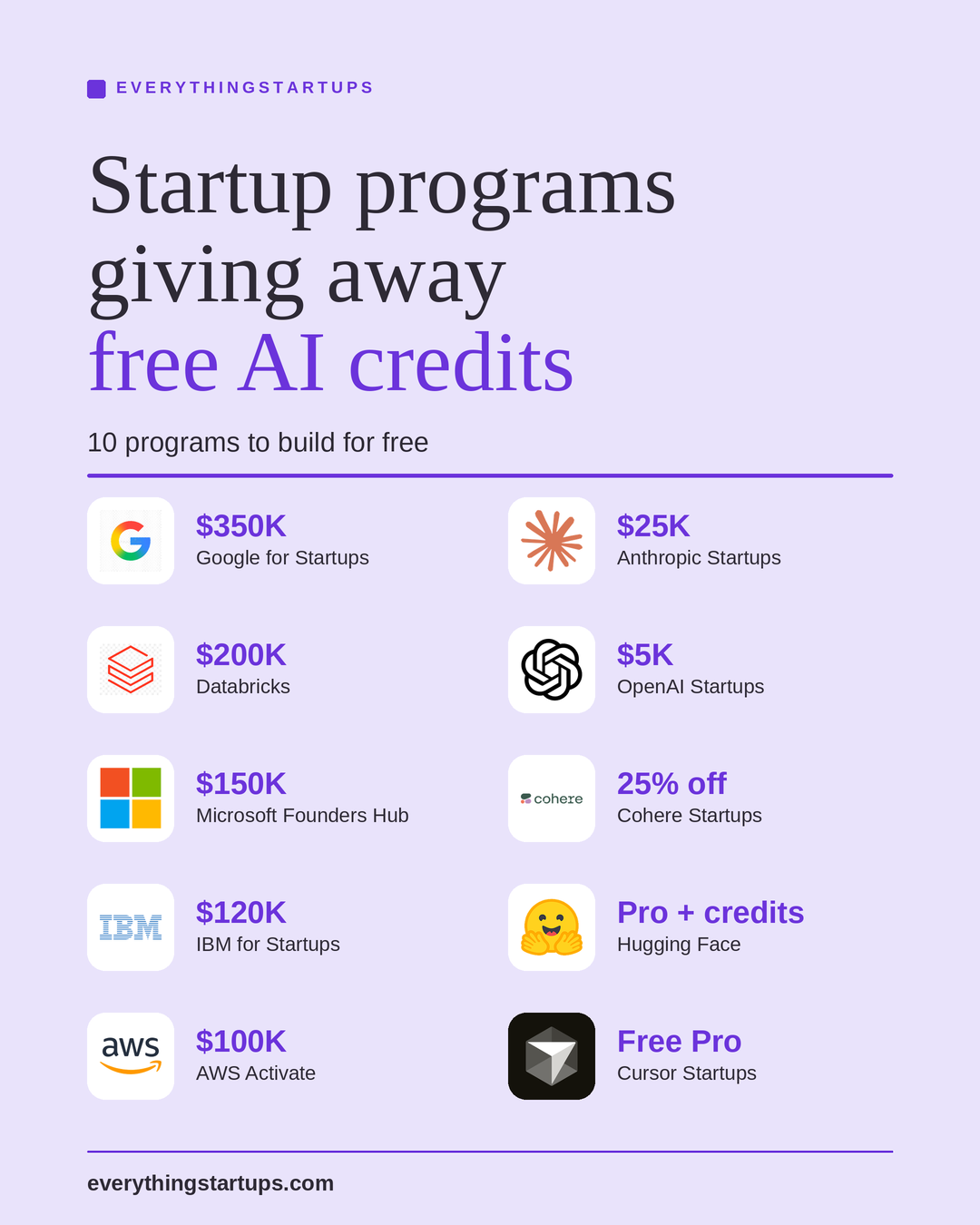
There is more than $800,000 in free AI credits sitting inside startup programs right now, and most early-stage founders walk past nearly all of it.
The money is real, it is non-dilutive, and for an AI company it can cover compute, model inference, and infrastructure for the better part of a first year.
The reason so few founders claim it has very little to do with eligibility and almost everything to do with discovery, because the offers are scattered across a dozen separate portals, each with its own referral gates, tier structures, and expiration clocks.
A founder who understands how these programs are actually structured, rather than just reading the headline numbers, can stack several of them at once and extend runway by months without raising a single additional dollar.
This guide breaks down what AI credits are, how startup credits actually get awarded, and the ten programs worth your time heading into 2026, ranked by how much each one will give you, with a clear application path for every single one.
A note before the list: every credit figure below is an "up to" ceiling, not a guarantee. The amount you receive depends on your funding stage, your traction, whether an investor or accelerator can refer you, and how convincingly your application maps your product to the provider's infrastructure. Treat the numbers as targets to aim for, and read each program against your own stage and stack.
What Are AI Credits?
AI credits are prepaid allowances that cover the cost of building and running AI products on a provider's platform, issued to qualifying startups in place of cash.
They typically pay for the three things that drain an early AI budget fastest, which are raw compute (the GPUs and servers that train and run models), model inference (every API call your product makes to a large language model), and the surrounding infrastructure (storage, databases, networking, and the managed services that tie it all together).
When people talk about free startup credits in an AI context, this is usually what they mean.
It helps to separate two overlapping categories that founders often blur together. Cloud credits come from the major infrastructure providers such as Google Cloud, Amazon Web Services, and Microsoft Azure, and they cover your whole technical stack including any AI workloads you run on top of it.
Model credits come directly from the AI labs such as Anthropic, OpenAI, and Cohere, and they cover usage of those specific models through an API.
The largest dollar figures in this guide come from the cloud providers, while the model labs tend to offer smaller but highly targeted credits that are valuable precisely because inference is where AI-native products bleed cash.
The obvious question is why any of these companies give away six figures of infrastructure to unproven startups. The answer is straightforward commercial logic rather than generosity.
Cloud and model providers spend very little at the margin to hand a startup credits, since the compute capacity exists whether it is used or not, and the lifetime value of a startup that grows into a major paying customer is enormous.
Anthropic is the cleanest illustration of the strategy working in reverse, having started on Amazon Web Services and grown into one of Amazon's most significant AI partners.
Startup credits are a long game for the provider, and the founder who understands that can negotiate the relationship from a position of clarity rather than gratitude.
How to Get Startup Credits
Before looking at individual programs, it is worth understanding the mechanics that nearly all of them share, because the same handful of rules determine how much you actually receive.
Most startup programs run in tiers rather than offering a single flat amount. There is usually a low-friction entry tier that any founder can self-apply for, often worth a few thousand dollars, and a much larger tier that unlocks only when an affiliated investor, accelerator, or incubator refers you.
The single most expensive mistake founders make is applying for the small self-serve tier when they already qualify for the large referred one, simply because nobody thought to ask their VC or accelerator for the referral code or organization ID that unlocks it.
If you have any institutional backing at all, your first move on any of these programs should be asking your investor whether they are an enrolled partner.
Timing matters more than most founders expect. Several programs require you to be early enough in your journey to qualify for the most generous tiers, which means applying after a large funding round closes can quietly disqualify you from the best offers.
Application review also takes time, commonly anywhere from a few business days for self-serve tiers to several weeks for the partner-referred and AI-specific tiers, so the practical move is to apply before you urgently need the credits rather than during a cash crunch.
Two further realities shape how you should plan. The first is that you are allowed to stack programs, since credits from a cloud provider, an AI lab, and a data platform are separate pools that do not cancel each other out, and the founders who extend their runway the most are running several applications in parallel rather than picking one.
The second is that nearly all of these credits expire, most commonly twelve months after they are issued, with no extensions and no cash value, so you should activate them only when you are ready to deploy real workloads against them rather than claiming them and letting the clock run down.
With those mechanics in mind, here are the ten programs worth applying to, ranked by the size of the credit on offer.
The 10 Startup Programs for Free AI Credits
1. Google for Startups Cloud Program: up to $350,000
Google runs the most generous published cloud credit program available in 2026, and its AI-first track sits at the top of this entire list. Qualifying AI-native startups can receive up to $350,000 in Google Cloud and Firebase credits over two years, while startups that are not AI-first top out at $200,000.
The credits cover Google's full machine learning stack, including Vertex AI, the Gemini models, and the underlying TPU and GPU compute that AI products consume at scale.
According to Google's own startup pages, the AI tier front-loads the benefit heavily, with the first year covering up to $250,000 in credits.
The program is built for startups whose product depends on AI rather than companies that plan to bolt on a chatbot later, so the strength of your application rests on showing genuine model training, inference, or retrieval workloads on Google's infrastructure.
How to apply for Google for Startups credits
Begin by confirming which path fits you, since the AI-first tier requires demonstrating that AI is central to your product rather than a peripheral feature.
Apply through the Google for Startups Cloud Program portal, and if you are backed by an accelerator or venture firm in Google's partner network, route your application through that relationship to reach the higher tiers.
In your application, map three things explicitly, which are the AI problem you are solving, the specific Google Cloud products you expect to use such as Vertex AI, and the reason your workload belongs on Google's stack, because vague AI descriptions are the most common reason applications land in the lower tier.
2. Databricks for Startups Program: up to $200,000
Databricks relaunched its startup program in June 2026 as a single consolidated offering, and qualifying venture-backed startups can now receive up to $200,000 in credits across both Databricks and Neon, its Postgres database service.
The combined credit gives early teams the app backend, the data platform, and the AI tooling they need to process large datasets and train machine learning models on one unified system, which removes a meaningful chunk of the infrastructure assembly work that usually slows down data-heavy products.
The program is purpose-built for early-stage, venture-backed companies, with a particular focus on founders who have recently raised institutional funding anywhere from pre-seed through Series A and are building their company on data and AI.
How to apply for Databricks for Startups credits
Submit a single application through the Databricks for Startups portal, since the 2026 relaunch consolidated everything into one form that unlocks access across the platform.
Because the program targets venture-backed startups specifically, mention your institutional funding round and, if your investor has a relationship with Databricks, ask them to flag your application.
Be concrete about the data and AI workloads you intend to run, because the program is explicitly looking for companies building their core product on data and AI rather than teams experimenting at the edges.
3. Microsoft for Startups Founders Hub: up to $150,000
Microsoft's Founders Hub is one of the most accessible programs on this list at its entry point, while still reaching a generous ceiling for funded companies.
The credits apply to Azure cloud services and include access to Azure OpenAI Service, which lets you run OpenAI's models through Azure's infrastructure and billing, alongside Cognitive Services and the broader Microsoft developer stack.
The program also bundles in tools that would otherwise cost a startup real money, including GitHub Enterprise and Microsoft 365.
The important nuance, and the one that catches founders out, is that the program splits into two distinct paths.
Any startup can self-apply for an entry tier worth up to $5,000, but the headline $150,000 figure requires a referral code from an investor, accelerator, or incubator inside Microsoft's Investor Network.
It is also worth knowing that direct OpenAI credits stopped flowing through Founders Hub in mid-2025, so the OpenAI models you access here run through Azure rather than OpenAI directly.
How to apply for Microsoft for Startups Founders Hub credits
Apply at the Microsoft for Startups portal, signing in with a personal Microsoft account rather than a work or school account for the self-serve path. If you have funding from a firm in Microsoft's Investor Network, request their referral code and enter it during the application to unlock the higher tiers, because without it you will be capped at the entry amount.
Prepare a clear product description and your business registration details ahead of time, since Microsoft uses your description and stage to assign your tier, and a strong technical write-up directly raises the credit level you are offered.
4. IBM for Startups: up to $120,000
IBM's program centers on enterprise AI, giving startups access to watsonx, its AI and data platform, alongside IBM Cloud infrastructure, with credits reaching up to $120,000 and no equity taken in return.
The offering is most compelling for startups building in regulated or enterprise-heavy spaces, where IBM's compliance posture and enterprise relationships carry real weight, and where watsonx's governance tooling can shorten the path to selling into large, cautious buyers.
How to apply for IBM for Startups credits
Apply through IBM's startup program page, and frame your application around enterprise or governed AI use cases, since that is where IBM's stack is strongest and where your application will resonate most.
Identify the specific watsonx and IBM Cloud services your product will rely on, and if you are targeting regulated industries such as finance or healthcare, make that explicit, because it aligns your company with the customers IBM most wants its startup program to attract.
5. Amazon Web Services (AWS) Activate: up to $100,000, or up to $300,000 for AI startups
AWS Activate is the oldest and most widely used cloud credit program, and it runs on a clear tier structure.
Bootstrapped founders can self-apply for a $1,000 Founders tier, startups affiliated with an approved accelerator or venture firm can reach up to $100,000 through the Portfolio tier, and AI startups building foundational models can access a dedicated generative AI tier worth up to $300,000.
The credits cover more than 200 AWS services, and since 2024 they have been redeemable against third-party foundation models through Amazon Bedrock, including Anthropic's Claude and Meta's Llama, which effectively turns your AWS credits into AI credits as well.
How to apply for AWS Activate credits
Start by asking your accelerator or venture firm for their AWS Activate organization ID, because that ID is the gate that unlocks the $100,000 Portfolio tier rather than the $1,000 self-serve one, and an expired ID is the single most common cause of rejected applications.
Apply through the AWS Activate page using a company email address rather than a personal Gmail account, since applications from generic email addresses are frequently rejected.
If you are building foundational AI models on GPU-heavy workloads, name the specific services you will use such as SageMaker, Bedrock, and Trainium, because the generative AI tier evaluates technical depth and typically expects a nomination from a recognized investor.
6. Anthropic Startup Program: up to $25,000 in Claude credits, with more via partners
Anthropic offers Claude API credits to early-stage startups building on its models, which power assistants, agents, and a wide range of natural language products.
The direct program centers on a credit grant in the region of $25,000, and startups backed by Anthropic's venture partners can reach higher amounts, with the broader program extending up to $100,000 or more for companies with the right backing and traction.
The credits apply across Claude's full model lineup and are valid for twelve months from issuance, which is a generous window compared to programs that expect near-immediate conversion to paid usage. Applications are reviewed on a rolling basis.
How to apply for Anthropic Startup Program credits
Apply through the Claude for Startups page, where the application itself is short and asks for a company email, your website, and a description of what you are building.
You will need a Claude Console account, meaning the API console rather than the consumer Claude app, set up before you apply.
If you are backed by one of Anthropic's partner venture firms or accelerators, mention that investor in your application, because it is the route to the larger credit tiers, and make a specific case for why Claude is central to your product rather than incidental to it.
7. OpenAI for Startups: up to roughly $5,000 in API credits
OpenAI's startup access provides API credits for its models, covering GPT, DALL-E, Whisper, and embeddings, and the credits are distributed primarily through partners rather than a self-serve form.
A baseline of around $2,500 is available through OpenAI's partnership with the corporate card company Ramp, and amounts of up to roughly $5,000 or more flow to portfolio companies of OpenAI's network of more than 200 venture and accelerator partners.
There is no large self-serve tier, so a partner relationship is effectively the price of entry, and credits expire twelve months after issuance.
How to apply for OpenAI for Startups credits
Confirm first whether your venture firm or accelerator is one of OpenAI's partners, since the most reliable path runs through a referral code from that relationship.
Apply through OpenAI's startup page using the referral route, and in your application be specific about your usage, describing the volume of API traffic and the models your product depends on rather than stating that you simply use GPT.
If you do not yet have a partner relationship, the Ramp path offers a smaller credit without a referral, and building a relationship with an OpenAI-partnered fund is the way to reach the higher amounts later.
8. Cohere Startup Program: discounted enterprise pricing for early-stage teams
Cohere's program takes a different shape from the credit grants above, offering early-stage startups a discount of around 25% on its enterprise large language models and embeddings rather than a fixed dollar credit, along with technical resources and support.
The model suits teams building search, retrieval, and other enterprise natural language features, and the discount structure can be more economical than a one-time credit for products that expect sustained, predictable inference volume over time.
How to apply for Cohere Startup Program credits
Apply through Cohere's startup program page, presenting your stage, your use case, and the natural language or embedding workloads you plan to run on its models.
Because the benefit is a discount on ongoing usage rather than a finite credit, frame your application around the durability of your expected usage, since a team with steady production volume is exactly the profile the discounted pricing is designed to serve.
9. Hugging Face Program: roughly six months of Pro plus inference credits
Hugging Face, the open-source backbone that much of the machine learning world builds on, offers qualifying startups around six months of its Pro tier together with inference credits, distributed largely through accelerators and partners.
The benefit unlocks access to pre-trained models, hosted inference for natural language and vision tasks, and the tooling for custom training, which makes it especially valuable for teams whose products are built on open models rather than a single proprietary API.
How to apply for Hugging Face Program credits
Because the program is distributed mainly through accelerators and partner organizations, the most direct route is to check whether your accelerator already bundles Hugging Face benefits into its perks package, and to claim them through that channel if so.
Where a direct application is available, present your open-source machine learning workloads and the specific models and inference needs your product relies on, since the program is oriented toward teams genuinely building on the open ecosystem.
10. Cursor for Startups: free Pro access plus bundled credits
Cursor, the AI-first code editor, rounds out the list with a program that gives startups free Pro access along with bundled credits, with the exact amount depending on the specific program path.
The benefit is aimed squarely at engineering velocity, since Cursor's value is in shipping code faster, and it is worth noting that students can separately access a full year of Cursor Pro for free, which is useful for very early or solo technical founders still in school.
How to apply for Cursor for Startups credits
Apply through Cursor's startup program page, and because the bundled credit amount is program-dependent, check whether your accelerator or partner network offers an enhanced Cursor tier before applying directly.
Present your team size and engineering needs clearly, and if you qualify for the student path instead, claim the full year of Pro through that route, since it requires only proof of active enrollment rather than a startup application.
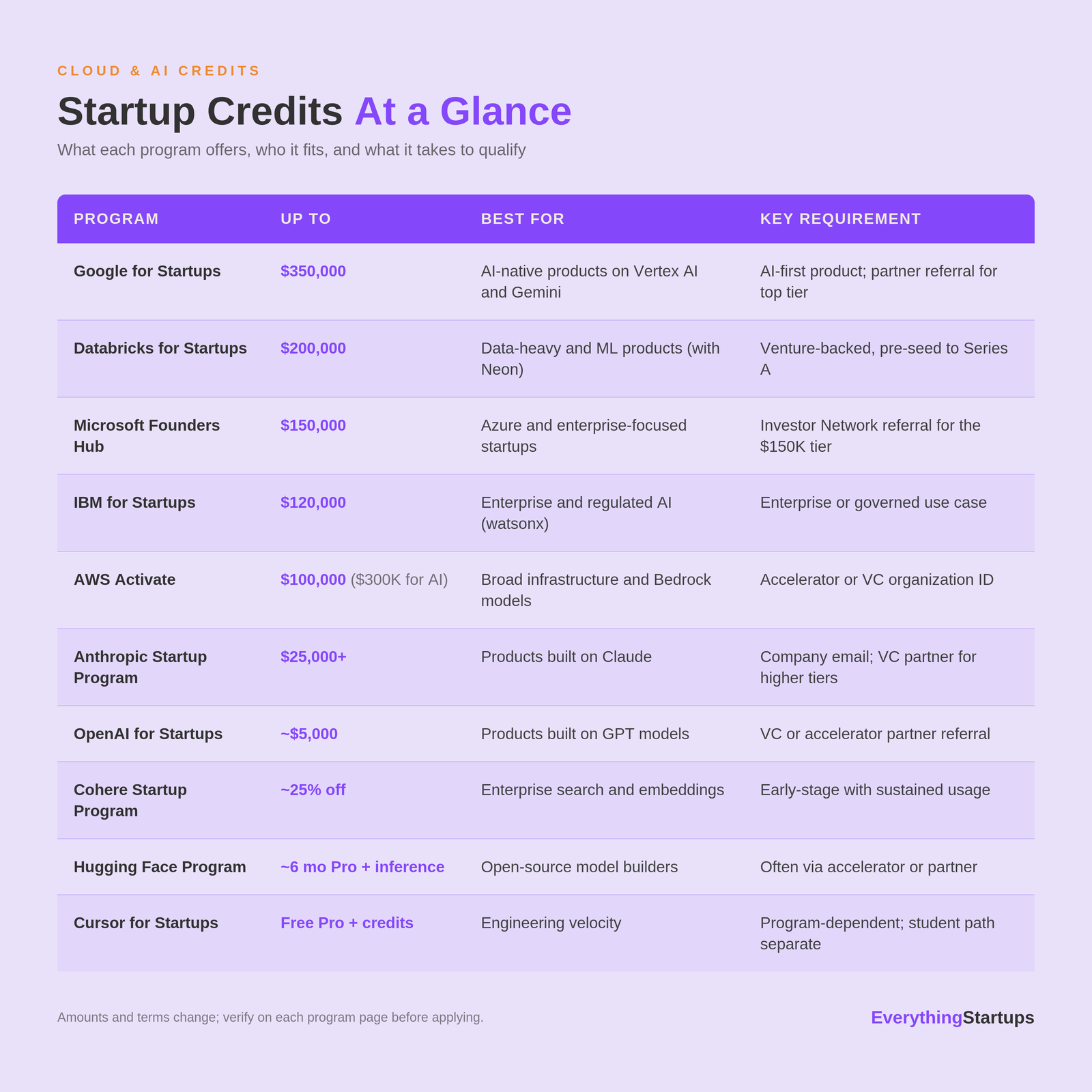
Startup Credits At a Glance
How to Stack and Sequence Your Applications
The founders who get the most out of these startup programs treat them as a portfolio rather than a single choice, and they apply in a deliberate order.
The sensible sequence starts with whichever cloud provider your product will actually live on, since that is your largest single credit and the foundation everything else sits on, followed by the AI model labs whose APIs your product calls, and finally the tooling programs such as Cursor and Hugging Face that improve your team's speed.
Because most of these credits expire roughly twelve months after issuance, you should sequence activation as well as application, claiming each credit only when you are ready to spend against it rather than triggering all the clocks at once.
There is one piece of judgment worth holding onto through all of this.
Credits should follow your technology decisions rather than drive them, because choosing a model provider or a cloud purely for the size of the credit is a fast way to end up rebuilding your stack in a year when the free balance runs out and the real bill arrives.
The Mistakes That Get Applications Rejected
A surprising share of rejections come down to avoidable errors rather than bad companies.
Here's a few:
- Applying with a personal email address instead of a company domain is among the most common, since several programs treat a generic address as a signal that the company is not real.
- A thin or placeholder website is another, because reviewers check that you have a functioning product and a credible web presence before approving meaningful credit.
- Applying for the wrong tier is the most expensive error of all, since founders who qualify for a six-figure partner tier routinely receive a four-figure self-serve amount simply because they never asked their investor for the referral code or organization ID.
- Mismatched information between your application and your public funding records can also stall a review, so it is worth making sure your application, your website, and your investor records tell the same consistent story.
FAQs
What are startup credits?
Startup credits are non-cash allowances that providers give to qualifying early-stage companies to cover the cost of using their products, most commonly cloud infrastructure, AI compute, and model APIs.
They function as runway, reducing the cash a startup burns on technical infrastructure during the period when it can least afford it.
Are these AI credits really free?
The credits themselves carry no cost and, importantly, take no equity in exchange, which makes them genuinely non-dilutive.
The realistic caveat is that they expire, usually within twelve months, and once the balance is gone you pay standard rates, so the value lies in using them well within the window rather than treating them as permanent free infrastructure.
Do I need venture funding to qualify?
Not always, since several programs including Microsoft Founders Hub, AWS Activate's Founders tier, and Anthropic's direct application offer a path for bootstrapped founders.
That said, the largest tiers on most programs are gated behind a referral from a venture firm or accelerator, so institutional backing meaningfully raises the ceiling on what you can receive.
Do startup credits expire?
Nearly all of them do, and the most common window is twelve months from the date the credits are issued, with no extensions and no cash value.
Because the clock starts at issuance rather than first use, the practical approach is to activate credits only when you are ready to deploy real workloads against them.
Can I apply to more than one program?
Yes, and stacking is where the real runway extension happens, since credits from a cloud provider, an AI lab, and a data platform are separate pools that do not offset one another.
Running several applications in parallel, sequenced around your actual infrastructure needs, is how founders assemble a combined balance well into six figures.
Extend Your Runway With Free Credits
Free startup credits will not find your product-market fit, but they will buy you the months of runway you need to go and find it yourself, which is exactly the kind of leverage an early-stage founder should be claiming rather than leaving on the table.
The $800,000 sitting across these ten programs is not reserved for a select few companies; it is mostly unclaimed because the application paths are fragmented and the referral gates go unmentioned.
Map your stack to the right programs, ask your investors for the codes that unlock the larger tiers, and apply before you need the money rather than after.
For more breakdowns like this, including our database of VC funds and the programs that actually move the needle for early-stage founders, subscribe to the EverythingStartups newsletter.