.png)
AI has moved from a promising category to the central focus of venture capital activity. Over the past few years, AI investors and AI venture capital firms have shifted a growing share of their capital, attention, and internal resources toward this space. What began as a set of experimental bets has now become a structured allocation strategy across funds.
This shift is visible in how firms deploy capital. Many of the top AI VC firms have launched dedicated vehicles or carved out specific mandates to invest in AI. Capital is flowing across multiple layers of the stack, including generative AI applications, core infrastructure such as compute and model layers, applied AI startups solving industry-specific problems, and developer tooling that enables others to build on top of these systems.
Large, multi-stage funds as well as specialized AI startup investors now treat AI as a primary investment theme rather than a side category. This has changed both the speed and scale at which capital moves. Funding cycles have compressed, competition for strong technical teams has intensified, and the bar for differentiation has become more clearly defined.
For founders, this creates both opportunity and complexity. There is more capital available than ever, but it is distributed across different types of venture capital AI investors, each with distinct expectations, strengths, and investment strategies.
The list below brings together 50 venture capital firms actively investing in AI today. More importantly, it serves as a starting point to understand who is funding AI, how these firms differ, and what that means when you decide to raise capital.
You can get the full details and contacts of AI venture capital investors over here.

- Venture Capital Archive Report 2025
Top 50 Venture Capital Firms Investing in AI
The firms listed below represent some of the most active AI investors and AI venture capital firms backing startups today. Each fund included here has recently raised new capital, as detailed in the EverythingStartups database, which means they are actively deploying and looking for new opportunities across the AI ecosystem.
For founders, this list is not just a directory of top AI VC firms, but a practical starting point to identify investors who are currently in market and ready to back the next generation of AI startups.
Andreessen Horowitz
Fund Size: $15B
HQ: United States
Stage Focus: Multi-Stage
AI Focus: Generative AI, crypto, infrastructure
Andreessen Horowitz is one of the largest venture capital firms investing in AI startups. The firm backs companies across all stages and has been involved in some of the biggest AI rounds globally.
Mighty Capital
Fund Size: $91M
HQ: United States Stage
Stage: Seed, Series A AI
Focus: AI infrastructure, enterprise AI
Mighty Capital is a San Francisco-based early-stage B2B technology investor that identifies outlier companies through its Product Alpha Effect™ methodology. Through Products That Count, portfolio companies gain direct distribution into 600,000+ product leaders, and its AI portfolio includes Groq, the AI inference company.
Thrive Capital
Fund Size: $10B
HQ: United States
Stage: Multi-Stage
Focus: AI infrastructure, generative AI
Thrive Capital is a New York-based venture capital firm that invests in software and technology companies across stages. The firm is known for making a small number of high-conviction bets and backing category-defining companies such as OpenAI, Stripe, and Databricks.
Lightspeed Venture Partners
Fund Size: $9B
HQ: United States
Stage: Multi-Stage
Focus: AI, enterprise software, infrastructure
Lightspeed Venture Partners is a global venture capital firm that invests across early and growth stages, with a strong focus on enterprise and consumer technology. The firm has been an active AI investor and focuses on AI infrastructure as well as applications that can scale into large markets.
Insight Partners
Fund Size: $12.5B
HQ: United States
Stage Focus: Multi-Stage
AI Focus: Enterprise AI, SaaS platforms, data infrastructure
Insight Partners focuses on high-growth technology companies and frequently invests in AI-driven enterprise software platforms. The firm often participates in large growth rounds for companies scaling AI technologies.
Coatue Management
Fund Size: $1B
HQ: United States
Stage Focus: Series A – Growth
AI Focus: AI platforms, fintech AI, enterprise software
Coatue Management invests in both public and private technology companies and has become a major investor in AI startups. The firm often leads late-stage funding rounds for fast-growing AI companies.
SignalFire
Fund Size: $1B
HQ: United States
Stage Focus: Seed, Series A, Series B
AI Focus: AI infrastructure, SaaS, enterprise AI
SignalFire is a technology-driven venture capital firm that uses data platforms to identify promising startups. The firm invests heavily in companies building AI-powered enterprise software and infrastructure tools.
Founders Fund
Fund Size: $4.6B
HQ: United States
Stage Focus: Multi-Stage
AI Focus: AI, defense technology, frontier tech
Founders Fund is known for backing ambitious technology companies working on transformative innovations. The firm actively invests in frontier technologies including AI, defense systems, and aerospace technologies.
Redpoint Ventures
Fund Size: $650M
HQ: United States
Stage Focus: Multi-Stage
AI Focus: AI infrastructure, enterprise software, cloud platforms
Redpoint Ventures invests in technology startups across multiple stages and sectors. The firm has increased its investment in AI companies building enterprise and cloud-based AI platforms.
Radical Ventures
Fund Size: $650M
HQ: Canada
Stage Focus: Seed, Series A
AI Focus: AI, robotics, machine learning
Radical Ventures is a venture capital firm dedicated specifically to AI startups. The firm partners closely with leading AI researchers and supports companies building advanced machine learning technologies.
Conviction Partners
Fund Size: $230M
HQ: United States
Stage Focus: Seed, Series A
AI Focus: Generative AI, AI infrastructure, developer tools
Conviction Partners focuses on early-stage companies building AI-native platforms and products. The firm invests in startups developing foundational infrastructure and generative AI technologies.
OpenAI Startup Fund
Fund Size: $44M
HQ: United States
Stage Focus: Pre-Seed, Seed, Series A
AI Focus: AI applications, developer tools, enterprise AI
The OpenAI Startup Fund supports startups building applications on top of advanced AI models. The fund invests in companies developing new AI-powered products and developer ecosystems.
NFX
Fund Size: $325M
HQ: United States
Stage Focus: Pre-Seed, Seed, Series A
AI Focus: AI platforms, SaaS, marketplaces
NFX is an early-stage venture capital firm that invests in startups with strong network effects. The firm has backed several AI companies building scalable enterprise platforms and developer tools.
Basis Set Ventures
Fund Size: $250M
HQ: United States
Stage Focus: Pre-Seed, Seed, Series A
AI Focus: AI infrastructure, edge computing, enterprise AI
Basis Set Ventures focuses on AI startups building the infrastructure and tooling that enable AI applications at scale.
Glasswing Ventures
Fund Size: $200M
HQ: United States
Stage Focus: Pre-Seed, Seed
AI Focus: AI security, cybersecurity AI, developer tools
Glasswing Ventures invests in early-stage AI startups focused on cybersecurity and enterprise software.
AI Fund
Fund Size: $190M
HQ: United States
Stage Focus: Pre-Seed, Seed
AI Focus: AI platforms, machine learning startups
AI Fund is a venture studio created to launch and fund startups built around AI technologies. The fund focuses on companies developing next-generation AI applications.
Amplify Partners
Fund Size: $900M
HQ: United States
Stage Focus: Seed – Growth
AI Focus: AI infrastructure, developer tools, data platforms
Amplify Partners invests in technical founders building the infrastructure layer for modern software systems, including AI developer tools and data platforms.
CRV
Fund Size: $750M
HQ: United States
Stage Focus: Seed – Series B
AI Focus: AI software, developer tools, cybersecurity
CRV is a venture capital firm investing in early-stage technology companies including startups building AI products and developer tools.
Felicis Ventures
Fund Size: $900M
HQ: United States
Stage Focus: Seed – Growth
AI Focus: AI platforms, enterprise AI, cybersecurity
Felicis Ventures backs companies building AI-driven software platforms and enterprise technologies.
Boldstart Ventures
Fund Size: $250M
HQ: United States
Stage Focus: Pre-Seed – Series A
AI Focus: AI infrastructure, enterprise software, cybersecurity
Boldstart Ventures focuses on technical founders building developer tools and AI-powered enterprise platforms.
Work-Bench
Fund Size: $160M
HQ: United States
Stage Focus: Seed, Series A
AI Focus: enterprise AI, developer platforms
Work-Bench invests in enterprise software startups and frequently backs companies building AI tools for developers and businesses.
Project A
Fund Size: $373M
HQ: Germany
Stage Focus: Pre-Seed – Series A
AI Focus: AI software, fintech AI, defense tech
Project A is a European venture capital firm investing in early-stage technology startups including AI companies across fintech and enterprise software.
Deep33 Ventures
Fund Size: $150M
HQ: United States
Stage Focus: Pre-Seed to Series B
AI Focus: AI infrastructure, edge computing, quantum technologies
Deep33 Ventures focuses on foundational technologies that enable AI at scale. The firm invests in startups building infrastructure across AI, edge computing, and advanced computing systems.
Digital Transformation Capital Partners
Fund Size: $590M
HQ: Germany
Stage Focus: Multi-Stage
AI Focus: AI infrastructure, generative AI, digital transformation
Digital Transformation Capital Partners invests in startups building next-generation digital infrastructure. The firm focuses on companies developing AI technologies that transform enterprise software, connectivity, and data platforms.
Striker Venture Partners
Fund Size: $165M
HQ: United States
Stage Focus: Seed
AI Focus: AI infrastructure, cybersecurity AI
Striker Venture Partners invests in early-stage startups building infrastructure for modern cloud and AI systems. The firm focuses on companies developing AI-powered cybersecurity and enterprise platforms.
Origin Ventures
Fund Size: $140M
HQ: United States
Stage Focus: Seed to Series A
AI Focus: AI infrastructure, enterprise AI
Origin Ventures backs startups building foundational technologies across enterprise software and AI. The firm focuses on companies developing scalable platforms and data-driven systems.
Essence VC
Fund Size: $41M
HQ: United States
Stage Focus: Pre-Seed, Seed
AI Focus: AI infrastructure, open computing
Essence VC focuses on early-stage startups building infrastructure that powers AI systems. The firm supports companies working on foundational computing and data technologies.
Valkyrie
Fund Size: $45M
HQ: United States
Stage Focus: Pre-Seed, Seed
AI Focus: Generative AI, AI infrastructure
Valkyrie invests in early-stage startups developing generative AI platforms and the infrastructure needed to support large-scale AI systems.
Somersault Ventures
Fund Size: $20M
HQ: United States
Stage Focus: Seed, Series A
AI Focus: Generative AI, AI infrastructure
Somersault Ventures focuses on startups building AI-native platforms and technologies that enable machine learning applications across industries.
Sugar Free Capital
Fund Size: $32M
HQ: United States
Stage Focus: Seed
AI Focus: Generative AI, AI infrastructure
Sugar Free Capital invests in early-stage companies developing generative AI technologies and infrastructure supporting modern AI applications.
Factorial Capital
Fund Size: $25M
HQ: United States
Stage Focus: Pre-Seed, Seed
AI Focus: Generative AI, edge computing
Factorial Capital backs startups developing advanced computing technologies and generative AI systems designed for distributed environments.
Vanagon Ventures
Fund Size: $23M
HQ: Germany
Stage Focus: Pre-Seed, Seed
AI Focus: AI infrastructure, data platforms
Vanagon Ventures invests in early-stage startups building infrastructure and data technologies that support AI systems.
GHARAGE Ventures
Fund Size: $46M
HQ: Germany
Stage Focus: Seed, Series A
AI Focus: Generative AI, tech-enabled services
GHARAGE Ventures focuses on startups using AI to transform enterprise services and software platforms.
Multimodal Ventures
Fund Size: $15M
HQ: United States
Stage Focus: Seed, Series A
AI Focus: Generative AI, B2B SaaS
Multimodal Ventures invests in early-stage companies building AI-native software products and generative AI platforms.
CoFound
Fund Size: $30M
HQ: United States
Stage Focus: Pre-Seed, Seed
AI Focus: Generative AI, SaaS
CoFound backs startups developing AI-powered SaaS platforms and tools designed for enterprise and developer ecosystems.
Belief Capital
Fund Size: $20M
HQ: United Kingdom
Stage Focus: Pre-Seed, Seed, Series A
AI Focus: Generative AI, edge computing
Belief Capital invests in early-stage startups developing advanced AI technologies including generative AI and distributed computing platforms.
Aneli Capital
Fund Size: $41M
HQ: Lithuania
Stage Focus: Pre-Seed, Seed, Series A
AI Focus: Generative AI, robotics
Aneli Capital focuses on early-stage startups building AI technologies including robotics and machine learning systems.
May Ventures
Fund Size: $35M
HQ: Germany
Stage Focus: Pre-Seed, Seed
AI Focus: Generative AI, SaaS
May Ventures invests in European startups building AI-driven software platforms and enterprise tools.
Leonis Capital
Fund Size: $25M
HQ: United States
Stage Focus: Pre-Seed, Seed
AI Focus: AI developer tools, robotics
Leonis Capital backs startups building developer tools and automation platforms powered by AI.
Sarah Smith Fund
Fund Size: $16M
HQ: United States
Stage Focus: Pre-Seed, Seed, Series A
AI Focus: Generative AI, infrastructure
Sarah Smith Fund invests in early-stage startups developing AI infrastructure and next-generation computing systems.
Phosphor Capital
Fund Size: $34M
HQ: United States
Stage Focus: Pre-Seed, Seed
AI Focus: AI developer tools, SaaS
Phosphor Capital focuses on startups building developer tools and enterprise software powered by AI.
Elaia
Fund Size: $142M
HQ: France
Stage Focus: Pre-Seed to Series B
AI Focus: AI, cybersecurity, techbio
Elaia is a European venture capital firm investing in deep technology startups including AI, cybersecurity, and advanced computing companies.
Picus Capital
Fund Size: $294M
HQ: Germany
Stage Focus: Multi-Stage
AI Focus: Generative AI, fintech AI
Picus Capital invests globally in technology startups including companies building AI-driven software platforms and fintech products.
Entrée Capital
Fund Size: $300M
HQ: Israel
Stage Focus: Pre-Seed to Series B
AI Focus: AI software, deeptech
Entrée Capital invests in early-stage technology startups globally and has backed several companies developing AI technologies.
Lifeline Ventures
Fund Size: $465M
HQ: Finland
Stage Focus: Pre-Seed to Series A
AI Focus: AI software, consumer AI
Lifeline Ventures supports early-stage startups building innovative technologies including AI platforms and software products.
Cherry Ventures
Fund Size: $500M
HQ: Germany
Stage Focus: Seed, Series A
AI Focus: AI software, fintech AI
Cherry Ventures invests in European startups building AI platforms, fintech solutions, and software products.
Headline Asia
Fund Size: $145M
HQ: Japan
Stage Focus: Seed to Series B
AI Focus: AI software, ecommerce AI
Headline Asia invests in technology startups across Asia including companies building AI-powered products for ecommerce and enterprise software.
BNVT Capital
Fund Size: $148M
HQ: United Kingdom
Stage Focus: Seed
AI Focus: AI, climate tech, energy
BNVT Capital backs startups developing AI technologies addressing challenges in climate, energy, and advanced computing.
Glilot Capital
Fund Size: $500M
HQ: Israel
Stage Focus: Seed
AI Focus: AI, cybersecurity, enterprise software
Glilot Capital invests in cybersecurity and enterprise AI startups developing advanced technologies for global markets.
Sorenson Capital
Fund Size: $150M
HQ: United States
Stage Focus: Seed to Growth
AI Focus: AI software, cybersecurity AI
Sorenson Capital invests in enterprise software companies and has backed several startups building AI and cybersecurity technologies.
2048 Ventures
Fund Size: $82M
HQ: United States
Stage Focus: Pre-Seed, Seed
AI Focus: Applied AI, edge computing
2048 Ventures invests in very early-stage startups building foundational technologies, including applied AI and distributed computing systems.
Types of Venture Capital Firms Investing in AI
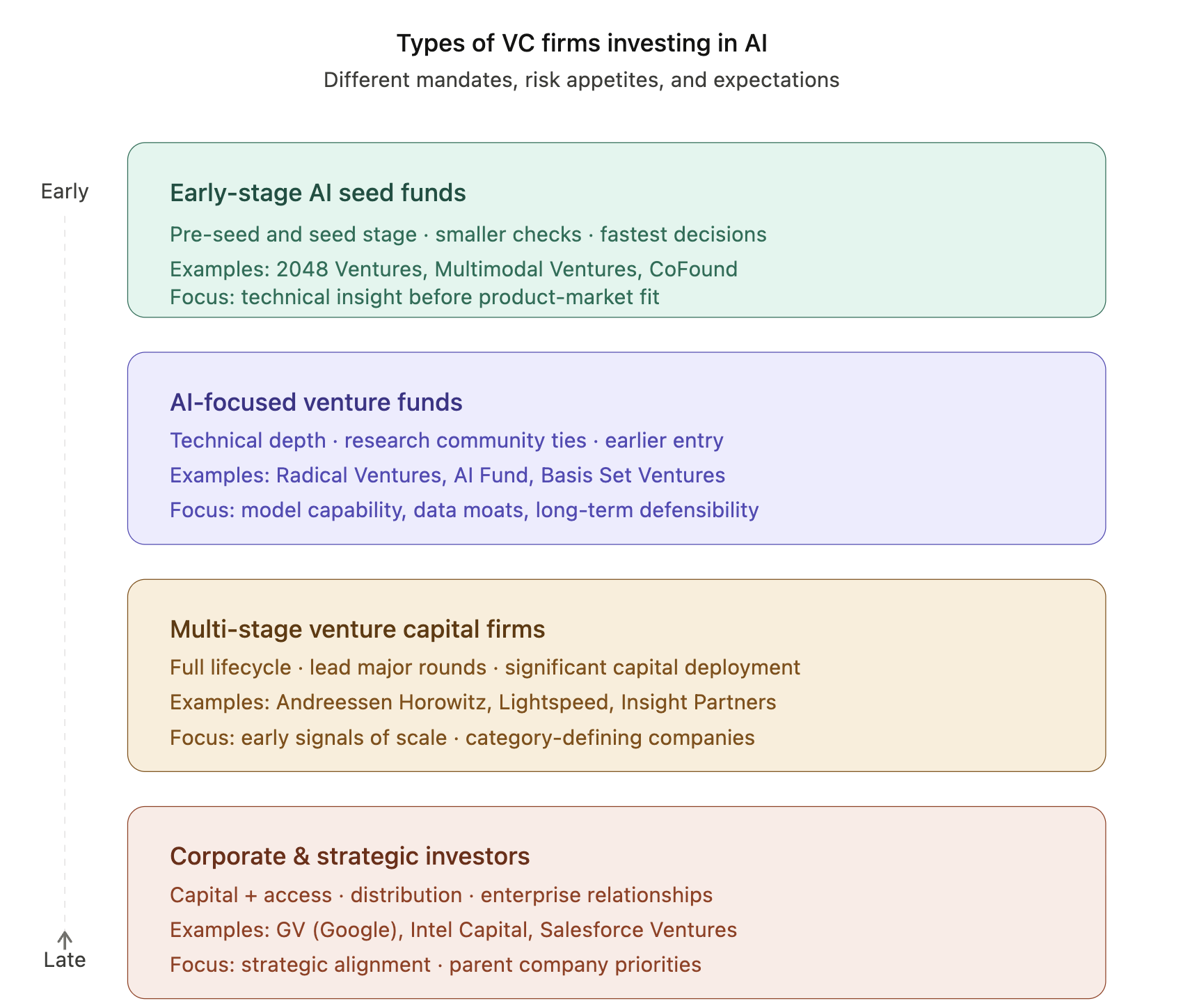
AI investors do not operate the same way. Different firms approach AI with different mandates, risk appetites, and expectations. For founders, this matters because the choice of investor shapes how the company is built over time.
When people look up the types of AI investors, they are usually trying to figure out who to approach and when. The answer depends on how a firm evaluates AI opportunities and not just on fund size.
1. Multi-Stage Venture Capital Firms
Large, established AI venture capital firms invest across the full lifecycle, from early-stage rounds to late-stage growth. Firms like Andreessen Horowitz, Lightspeed Venture Partners, and Insight Partners fall into this category.
These firms deploy significant capital and often lead major rounds. Their interest in AI spans infrastructure, applications, and platform companies. What defines them is their focus on companies that can grow into large outcomes.
From a founder’s perspective, these investors look for early signals of scale. Even at the seed stage, they evaluate whether a company can become a category leader. A strong technical story helps, but it needs to translate into a business that can expand quickly and sustain that growth.
2. AI-Focused Venture Funds
Some firms focus entirely on AI. Investors like Radical Ventures, AI Fund, and Basis Set Ventures represent this group of AI startup investors.
These funds operate with a different lens. Their edge comes from technical depth and close ties to research communities. Many have partners with backgrounds in machine learning or academic AI, which shapes how they evaluate companies.
They spend more time on model capability, data advantage, and long-term defensibility. In many cases, they are comfortable investing earlier because they can assess technical risk more directly. For founders building in core AI layers or technically complex products, these investors often provide stronger alignment.
3. Early-Stage AI Seed Funds
A growing segment of venture capital AI investors focuses on pre-seed and seed-stage companies. Firms such as 2048 Ventures, Multimodal Ventures, and CoFound are part of this group.
These funds are designed to work with founders at the earliest stages, often before product-market fit is established. Their role is to help founders reach a credible first institutional round.
They tend to move quickly, write smaller checks, and spend more time on early decisions such as product direction, hiring, and positioning. In AI, this stage often begins with a technical insight that has not yet become a clear product. These investors are comfortable operating in that uncertainty.
4. Corporate and Strategic AI Investors
Corporate venture arms and strategic investors such as GV (Google Ventures), Intel Capital, and Salesforce Ventures form another category.
These investors combine capital with access. They can open doors to distribution, infrastructure, and enterprise relationships. Their investment decisions often align with the strategic priorities of the parent company.
For founders, this can accelerate growth if there is a clear fit. It can also shape how the company positions itself over time, so these partnerships require careful consideration.
What Venture Capital Investors Look for in AI Startups
The way AI investors evaluate startups has shifted. A strong pitch or demo is no longer enough, most AI venture capital firms now focus on a few core questions: does the product work in real conditions, can it scale economically, and will it improve over time?
For founders trying to understand what investors look for in AI startups, the answer comes down to three things: technology, economics, and adoption.
Model Capability and Reliability
Investors want to see consistent real-world performance, not just controlled demos. They look for performance across varied inputs, stability over repeated use, and clear understanding of failure cases. Teams that understand limitations tend to build more trust than those making broad claims.
Data Advantage
Most AI startup investors focus on whether data creates a lasting edge. They assess access to proprietary or hard-to-replicate data, Whether the system improves with usage, and how easily competitors can match performance. Without a data advantage, differentiation becomes difficult as models commoditize.
Distribution and Adoption
A strong product needs a clear path to users. Investors look at who the early users are and how they are acquired, how quickly usage becomes consistent, and whether the product fits into existing workflows. Early interest matters less than sustained usage.
Cost Structure and Unit Economics
AI products often have non-trivial cost structures. Investors evaluate cost per user or request, how costs change with scale, and whether pricing supports sustainable margins. Growth without cost control creates pressure later.
Retention and Product Value
Retention is one of the clearest signals of value. Investors look for things like ongoing usage beyond onboarding, reliance on the product for real tasks, and expansion within teams. Retention shows whether the product solves a meaningful problem.
Clarity of Category and Positioning
Unclear positioning is a common issue in AI startups. Investors prefer a defined problem and user, focused starting point, and a clear path to expansion. Clarity makes both the opportunity and execution easier to evaluate.
Across all of this, venture capital AI investors are asking a practical question: does the technology translate into a business that can grow, sustain itself, and defend its position over time.
Why Venture Capital Firms Are Investing Heavily in AI
The surge in funding from AI investors is not driven by hype. Venture capital tends to concentrate around shifts that change how products are built and how markets operate. AI fits that pattern, driven by technology maturity, new infrastructure layers, and changes in how companies spend on software.
A Platform Shift That Changes How Software Is Built
Each major wave of venture capital follows a shift in how software is created. Cloud reduced the cost of building companies. Mobile changed how users interacted with them. AI is now changing how products are developed and how quickly they improve.
Teams can build and iterate faster because models handle work that previously required manual effort. This shortens development cycles and allows smaller teams to reach scale earlier. For investors, this expands the number of companies that can achieve meaningful traction.
The Emergence of a New Infrastructure Layer
AI has introduced a new infrastructure layer alongside traditional cloud services, including model providers, data pipelines, and deployment tooling. For venture capital AI investors, this creates multiple points of entry across infrastructure, developer tools, and applications, each with distinct economics and risk profiles.
Budget Reallocation Across Enterprises
Enterprise spending is shifting toward AI. Companies are reallocating budgets from existing software categories rather than simply adding new tools. Automation replaces manual workflows, tools consolidate into AI-driven systems, and spending on data and model integration increases. This signals where future revenue will concentrate.
Faster Time to Product, Higher Pressure on Distribution
AI reduces the time required to build a functional product, but it also increases competition. More teams can reach similar levels of capability quickly. This shifts the focus toward distribution, access to users and data, and the ability to iterate once the product is in use.
The Potential for Durable Advantages
Despite concerns about commoditization, many AI startup investors still see paths to long-term advantage. These advantages come from integration into workflows, systems that improve with usage, and data loops that strengthen performance over time.
Taken together, these dynamics explain why capital continues to concentrate in AI. For top AI VC firms, the opportunity is not just about backing individual companies, but about participating in a shift that is reshaping how software is built and used across industries.
How Founders Can Raise Venture Capital for Their AI Startup
Raising capital from AI investors follows a familiar pattern, but expectations have shifted. Most AI venture capital firms now look for both technical depth and early signs of a working business. Strong pitches connect how the system performs with how the company will grow.
Build Technical Credibility
Investors want to see practical understanding of the technology. This does not require academic credentials, but it does require showing that the product goes beyond a thin layer on top of existing models. Founders who stand out can clearly explain how their system works, where performance improves, and how they manage trade-offs such as latency, cost, and accuracy.
Read our guide on how to raise money from a VC as a founder.
Demonstrate Model Performance
A working product carries more weight than a concept. AI startup investors look for consistent performance in real use. This means showing how the system behaves across different scenarios, how it compares to alternatives, and how limitations are handled. Teams that acknowledge constraints and show progress tend to build stronger trust.
Show Real Customer Traction
Even at an early stage, usage matters. Investors look for signs that the product solves a real problem, whether through returning users, early revenue, or evidence that the product is part of ongoing workflows. Traction does not need to be large, but it needs to be credible.
Develop Defensible Data Advantages
Many venture capital AI investors focus on how a company improves over time. Data is central to that story. Founders should be able to explain what data they capture, how it improves performance, and why it cannot be easily replicated. A clear data advantage helps investors understand long-term positioning.
Know What Each Stage Requires
Expectations change across funding stages. At pre-seed, investors focus on the team, the problem, and a clear technical direction. At seed, they expect a working product and early usage. By Series A, the focus shifts to consistent traction, a defined use case, and improving economics. At Series B and beyond, investors evaluate growth, retention, and operational efficiency.
Raising from top AI VC firms comes down to alignment. Founders who combine technical strength with real usage, and who understand what each stage demands, tend to move through the process with greater clarity.

Frequently Asked Questions (FAQs)
Which venture capital firms are actively investing in AI startups in 2026?
Several well-known AI venture capital firms are actively funding AI startups, including Andreessen Horowitz, Lightspeed Venture Partners, Radical Ventures, and SignalFire. These firms invest across different stages and focus areas, from early-stage AI applications to large-scale infrastructure companies.
How can AI startups raise funding from venture capital investors?
To raise capital from AI investors, startups need to demonstrate strong technical capability, clear model performance, and early signs of real-world usage. Investors also look for a defensible data advantage and a clear path to building a scalable business.
What kinds of AI startups do venture capital firms invest in?
Most AI startup investors focus on companies building across key segments of the AI stack, including generative AI applications, infrastructure such as models and compute layers, enterprise AI software, developer tools, and automation or robotics solutions.
Is venture capital still investing heavily in AI startups?
Yes, AI remains one of the most actively funded sectors for venture capital AI investors. Capital continues to flow into both early-stage and growth-stage AI companies, with many of the top AI VC firms treating AI as a core investment focus.