If you are building an AI startup, there is a good chance you are paying for infrastructure you could be getting for free. Cloud providers, AI labs and a growing number of founder residencies run AI startup programs that hand out credits, tools and in some cases cash, and most early teams only claim a small part of what they qualify for.
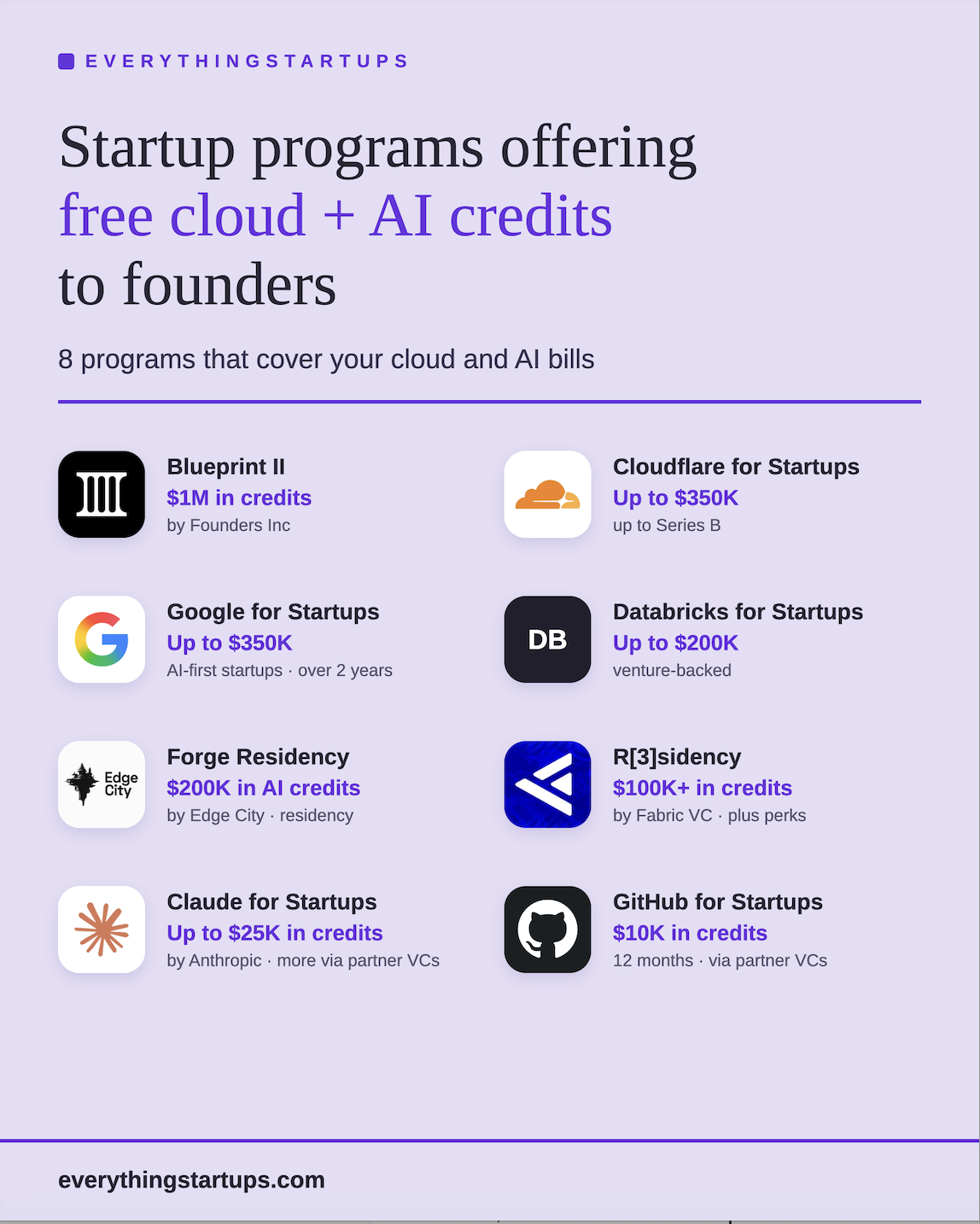
This guide covers eight of the best startup programs for AI companies in 2026. The first five are credit programs from Google, Cloudflare, Databricks, Anthropic and GitHub. The last three are residencies that combine an investment with credits from their partners.
For a wider list of cloud and model credit offers, including AWS, Microsoft, OpenAI and Hugging Face, our guide on how to get startup credits walks through ten more programs and how to apply to each one.
What Are AI Startup Programs?
AI startup programs are offers from technology companies and investors that give early-stage AI teams free or discounted access to the infrastructure they build on. Most of them give credits for cloud compute, model APIs or developer tools. Some, usually run by venture firms or founder communities, add a cash investment, a residency and hands-on help with product and fundraising.
Providers run these programs because a startup that builds on their platform early tends to stay with it as it grows into a paying customer. For founders, that means the credits are real and do not cost any equity, but they usually expire within a year or two, and the largest tiers are often reserved for companies backed by a partner investor or accelerator.
8 Best Startup Programs for AI Companies
1. Google for Startups Cloud Program (AI tier)
What you get: Up to $350,000 in Google Cloud credits over two years
Best for: AI-first startups building on Gemini
Google's AI startup program is the largest published cloud credit offer for AI teams. AI-first startups can receive up to $250,000 in credits in the first year and up to $100,000 more in the second, and the credits cover Google's own models such as Gemini and Gemma along with the wider Google Cloud stack, including GPU and TPU compute.
The AI tier is built for venture-backed startups founded within the last five years that raised a pre-seed or seed round in that time, or a Series A in the last twelve months, and that have not already received more than $5,000 in Google Cloud credits. Third-party models on Google Cloud are billed separately and are not covered, so this pool works best if Gemini sits at the center of your product.
2. Cloudflare for Startups
What you get: $10,000, $100,000 or up to $350,000 in credits for one year
Best for: Teams that need hosting, security and scaling infrastructure, including bootstrapped founders
Cloudflare for Startups runs three tiers. The $10,000 tier needs no minimum funding, which makes it one of the few meaningful credit offers open to bootstrapped teams. The $100,000 tier adds an account manager and technical sessions with Cloudflare engineers, and the $350,000 tier adds office hours and priority support.
The two larger tiers are generally tied to funding from a Cloudflare-affiliated investor, so ask your VC or accelerator whether they are a partner before you apply. Credits cover usage-based services such as Workers, R2, D1 and Workers AI, and they only apply once you go beyond Cloudflare's free tier. Core security and networking features are included at no cost on every tier.
3. Databricks for Startups
What you get: Up to $200,000 in credits across Databricks and Neon
Best for: Data and AI startups that have raised institutional funding
Databricks relaunched its startup program in June 2026 as a single offer covering both the Databricks data and AI platform and Neon, its serverless Postgres database. That gives an early team its app backend, data pipelines and model training tools in one place.
The program targets venture-backed companies from pre-seed through Series A that are building their core product on data and AI. Mention your funding round in the application and, if your investor works with Databricks, ask them to flag it.
4. Claude for Startups by Anthropic
What you get: Up to $100,000 in Claude API credits through partner VCs, plus partner offers worth up to $45,000
Best for: Startups using Claude as part of their core product
Anthropic's Claude for Startups program is open to bootstrapped, pre-seed and venture-backed companies. Members get the Claude Startup Stack, a set of discounts and credits from AI-native tools worth up to $45,000, along with office hours with Anthropic's Applied AI team and invitations to founder events and hackathons.
The larger credit pool runs through investors. Startups backed by a VC in Anthropic's partner network may be eligible for up to $100,000 in additional API credits, claimed through that firm. Anthropic currently lists its direct $1,000 API credit and free Claude Team offer as over capacity, and program credits only work on the first-party Claude API, so they cannot be spent through AWS Bedrock or Google Vertex AI.
5. GitHub for Startups
What you get: $10,000 in GitHub platform credits for twelve months
Best for: Engineering teams that want Copilot and built-in security tooling
GitHub for Startups gives eligible teams $10,000 to spend across GitHub Enterprise, Copilot (including premium models and the coding agent), Advanced Security, Actions and other metered features. The offer is distributed mainly through GitHub's network of venture and accelerator partners.
It can only be redeemed once, and startups that already received GitHub Enterprise credits through Microsoft or GitHub are not eligible, so it is worth timing your application for when the team is large enough to use the seats.
AI Startup Programs That Bundle Credits With Funding
The next three programs are residencies and accelerators. They are far more selective and run in cohorts, but they pair an investment with credits from partners, which can cover most of a young company's infrastructure costs while the team builds.
All three current cohorts have already closed applications, so treat them as programs to watch for the next intake. If you want more options at this stage, our list of 45 startup accelerators that back founders before traction covers programs with rolling or upcoming deadlines.
6. Blueprint II by Founders, Inc.
What you get: $150,000 investment per team plus $1M in credits
Format: Three months in person in San Francisco, then up to a year in the hardware lab
Blueprint II is a program from Founders, Inc. for founders building hardware and frontier technology, including robotics, drones, space, energy, chips, new materials and frontier AI models. The current cohort of 30 teams runs from September 30 to December 11, 2026.
Each team receives a $150,000 investment on a SAFE for 5%, according to the program FAQ, along with access to the Founders, Inc. campus, labs and machines and $1M in credits. Solo founders are eligible, and teams can keep working from the hardware facility for up to a year after the program ends. Applications for this cohort closed on September 14.
7. Forge Residency
What you get: AI and infrastructure credits from partners, housing, and fundraising support
Format: A 22-day live-in residency in Goa, India
Forge is a founder residency where a cohort of 12 to 14 founders live and build together for about three weeks. Its current cohort runs in Mandrem, Goa, from October 11 to November 1, 2026, as the founder house inside Edge City India.
Founders get a place to live, hands-on help with product and their fundraising story, investor introductions and AI and infrastructure credits from partners including OpenAI, ElevenLabs, PostHog, Stripe and Linear. Forge says its first 12 founders have raised more than $7 million combined, and it has launched a $15 million fund to keep backing founders after the residency ends.
8. R[3]sidency × Construct
What you get: $300,000 investment per team, follow-on funding of up to $1M and more than $100,000 in credits and perks
Format: 12 weeks in person across London and New York
R[3]sidency × Construct is an accelerator run by Fabric Ventures and Wintermute, with Solana as a core ecosystem partner and support from Coinbase. It backs teams at the intersection of crypto, fintech, AI, robotics and quantum computing.
Each of the eight teams in the cohort receives $300,000 in exchange for equity and a future token allocation, with potential follow-on funding of up to $1 million and more than $100,000 in partner credits and perks. The program runs from a London co-working space before a demo day and investor roadshow in New York. Applications for the current cohort closed on September 15.
AI Startup Programs at a Glance
- Google for Startups (AI tier): up to $350,000 in cloud credits over two years
- Cloudflare for Startups: $10,000 with no funding required, up to $350,000 through partner investors
- Databricks for Startups: up to $200,000 across Databricks and Neon
- Claude for Startups: up to $100,000 in API credits through partner VCs, plus up to $45,000 in partner offers
- GitHub for Startups: $10,000 in platform credits for twelve months
- Blueprint II: $150,000 investment plus $1M in credits
- Forge Residency: partner AI and infrastructure credits plus a 22-day residency
- R[3]sidency × Construct: $300,000 investment plus more than $100,000 in credits and perks
How to Get the Most Out of AI Startup Programs
Ask your investors which programs they partner with
The biggest tiers at Google, Cloudflare, Anthropic and GitHub run through partner VCs and accelerators. Many founders apply to the small self-serve tier when their investor could have unlocked a much larger one with a referral code, so send your investors a short note listing the programs you plan to apply to and ask which ones they can help with.
Stack programs that cover different parts of your stack
Credits from a cloud provider, a model lab and a developer tool come from separate budgets, so you can hold several at once. A sensible order is to start with the cloud your product will run on, add the model provider your product calls most, and then add tools like GitHub that speed up the team.
Apply early and activate credits when you need them
Several programs use your funding stage and company age to decide your tier, so applying after a large round can push you out of the most generous offer. Most credits also expire about a year after they are issued, so start the clock only when you have real workloads ready to run.
Choose your tools first and the credits second
Picking a cloud or model provider just because of the size of its credit offer can leave you rebuilding your stack once the free balance runs out. Decide what your product needs, then claim the credits that match those choices.
Frequently Asked Questions
What are the best startup programs for AI companies?
For credits alone, Google for Startups and Cloudflare for Startups offer the largest pools at up to $350,000 each, followed by Databricks at up to $200,000. Anthropic and GitHub add model and developer tool credits on top. For founders who also want funding, Blueprint II and R[3]sidency × Construct invest $150,000 and $300,000 per team alongside their credit packages.
What are AI startup programs?
AI startup programs are offers from cloud providers, AI labs, developer tool companies and investors that give early-stage AI teams free credits, discounted tools and sometimes funding. Credit programs like Google for Startups and Cloudflare for Startups cover infrastructure costs, while residencies like Blueprint II and R[3]sidency also invest cash in each team.
Can bootstrapped founders get AI startup credits?
Yes. Cloudflare's $10,000 tier has no minimum funding requirement, and Anthropic's Claude for Startups program is open to bootstrapped companies. The largest credit tiers on most programs still require backing from a partner VC or accelerator.
Do AI startup credits expire?
Almost always. Cloudflare and GitHub credits are valid for one year, and Google's AI tier spreads its credits over two years. Unused credits have no cash value once they expire.
Can I join more than one AI startup program?
Yes. Credits from different providers do not cancel each other out, and most founders who stretch their runway the furthest combine a cloud program, a model provider program and one or two tool programs.
What is the difference between a credit program and a startup residency?
A credit program gives you free usage of one company's products and takes no equity. A residency or accelerator such as Blueprint II or R[3]sidency invests money in exchange for equity, runs as a selective cohort and usually bundles credits from several partners along with mentorship and investor introductions.
Find Investors Who Can Unlock More
Many of the largest credit tiers depend on who your investors are, which makes choosing the right fund matter even before the money arrives. If you are raising, the EverythingStartups New VC Funds Database tracks newly announced funds every week, with check sizes, stage and focus for each firm.
For founders at the earliest stage, our guide to the best pre-seed funds that invest at the idea stage lists firms that will back a team before there is a product, and our list of the best seed funds for first-time founders covers the round after that.


.png)