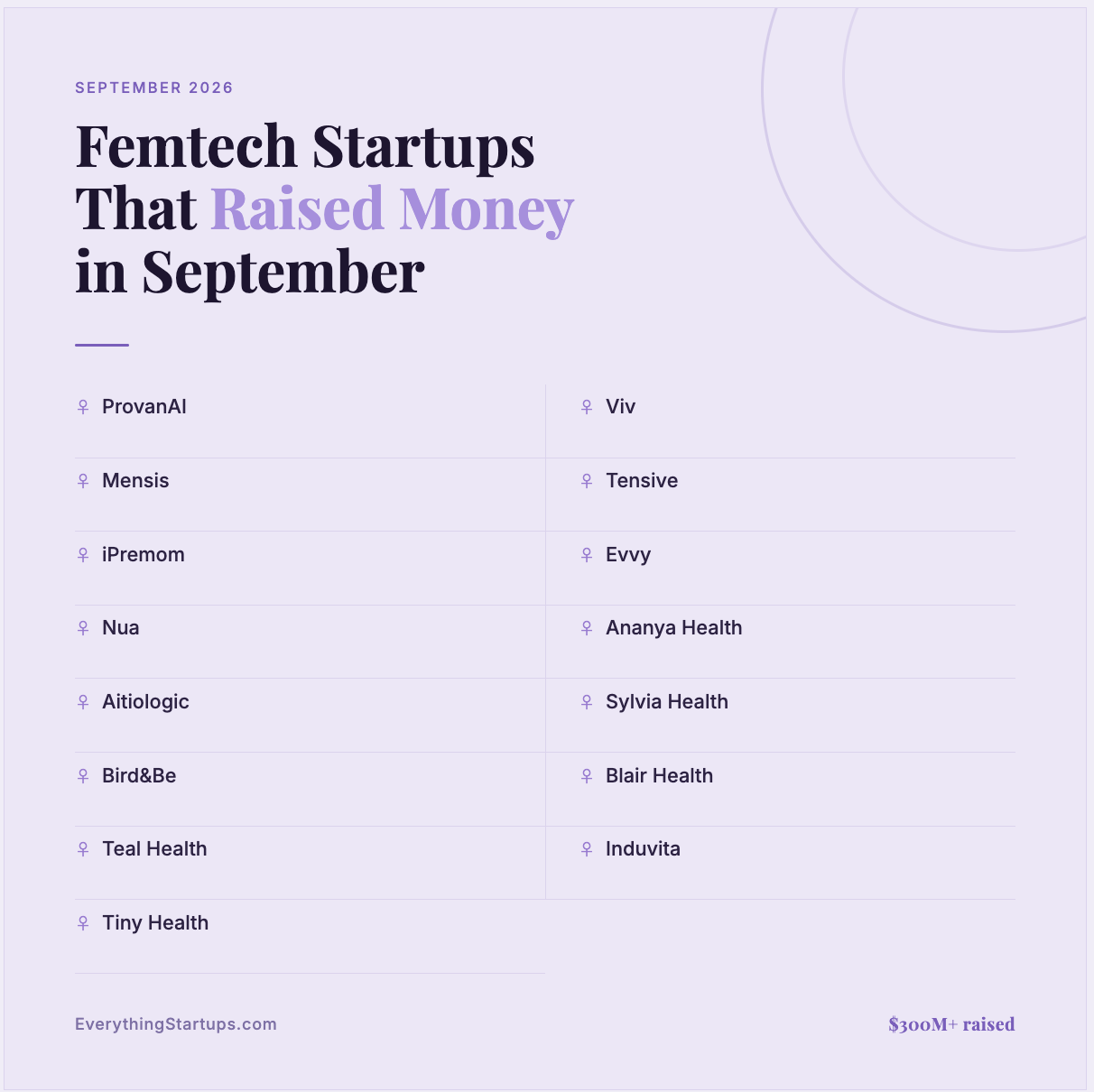
Femtech startups raised well over $300M in September 🔥
Here's a quick roundup of the femtech startups that raised money last month.
If you're tracking who's writing checks into this space, our VC Funds Database tracks the funds actively investing in femtech and women's health right now, including check size, stage, and thesis, updated weekly.
Funding Rounds in Femtech for September 2026
♀️ ProvanAI raised $1.2M for AI-powered ovarian cancer risk prediction from a mammogram.
→ Founded by: Joy Jiang and Graham Colditz
→ About: Use AI to predict a woman's five-year risk of ovarian cancer from a standard mammogram image — no additional imaging or biopsy required.
♀️ Viv secured $2M to scale the Cottonlock Tampon, designed to leave zero fiber residue behind.
→ Founded by: Katie Diasti and Anna Sise
→ About: Expand nationwide distribution for its patented Cottonlock Tampon, engineered to lock cotton fibers in place and eliminate residue left behind during use.
♀️ Mensis secured ~$110K for a wearable biosensor for continuous hormonal monitoring.
→ About: Build a wearable biosensor that collects hormonal data continuously throughout the day, moving beyond the single-point snapshot of a blood test to give women and clinicians a fuller picture of hormonal health.
♀️ Tensive secured up to $22M for a bioresorbable breast reconstruction scaffold.
→ About: Advance REGENERA, a bioresorbable scaffold designed to replace removed tumor tissue during lumpectomy with the patient's own natural tissue, eliminating the need for synthetic implants in breast reconstruction.
♀️ iPremom raised $16.5M for a blood test detecting pregnancy complication risk in the first trimester.
→ Founded by: Prof. Carlos Simón and Dr. Tamara Garrido
→ About: Clinically validate and commercialize the MaiRa platform, which identifies women at elevated risk of preterm birth, preeclampsia, and other pregnancy complications from a single blood draw in the first trimester.
♀️ Evvy raised $40M to scale its AI-powered vaginal microbiome platform into fertility.
→ Founded by: Priyanka Jain, Laine Bruzek, and Pita Navarro
→ About: Scale its AI-powered vaginal microbiome diagnostic platform and expand into fertility, building on the world's largest clinical-grade vaginal microbiome dataset to connect microbiome composition to reproductive outcomes.
♀️ Nua secured $50M Series C to scale period care and intimate hygiene across India.
→ Founded by: Ravi Ramachandran and Abhishek Ramanathan
→ About: Expand distribution, accelerate R&D, and grow its product portfolio across period care, intimate hygiene, and maternity care, cementing its position as India's leading feminine wellness brand.
♀️ Ananya Health secured $100K toward FDA clearance for a cryoablation device for cervical precancer.
→ Founded by: Anu Parvatiyar and Julie Yip
→ About: Progress toward FDA clearance for its battery-powered cryoablation device, designed to freeze precancerous cervical cells at the point of care — no cryogen gas required, making it viable in low-resource settings where cervical cancer burden is highest.
♀️ Aitiologic raised $7M for a liquid biopsy detecting preeclampsia risk from a first-trimester blood draw.
→ Founded by: Dr. Andreas Posch
→ About: Advance large-scale clinical validation of its Aitios liquid biopsy platform, which identifies preeclampsia risk from a blood draw already taken in routine first-trimester prenatal screening — no additional test or visit required.
♀️ Sylvia Health secured $615K to advance a rectocele prolapse device toward regulatory clearance.
→ Founded by: Andrew Stretton, Nikolaj Ulrik Friis, and André Amtoft
→ About: Move its rectocele prolapse device through manufacturing preparation and regulatory submission, targeting a condition affecting millions of women that has seen little device innovation for decades.
♀️ Bird&Be raised $13M to expand fertility supplements and tests for women and men.
→ Founded by: Samantha Diamond and Breanna Hughes
→ About: Expand product development, clinical research, and retail distribution for its evidence-based fertility and reproductive health supplement range, one of the few brands in the space that serves both women and men.
♀️ Blair Health raised $3.1M for a platform enabling generalist providers to deliver specialist-level women's care.
→ Founded by: Madge Rumman and Dr. Lindsay Shirreff
→ About: Expand its clinical infrastructure platform that gives generalist providers the tools, protocols, and decision support to deliver specialist-level care across menopause, pelvic health, and urology — without requiring a specialist referral.
♀️ Teal Health raised $22M to scale the first FDA-authorized at-home HPV self-collection device.
→ Founded by: Kara Egan and Dr. Avnesh Thakor
→ About: Scale to meet accelerating demand for the Teal Wand, the first FDA-authorized device for at-home HPV self-collection, ahead of broad insurance coverage set to begin in 2027 — a milestone that could make it the default cervical screening option for millions of women.
♀️ Induvita raised $680K to commercialize a redesigned vaginal speculum and induction-of-labour catheter.
→ Founded by: Hege Hansen and Dr. Stine Andreasen
→ About: Bring its Vega vaginal speculum to market — a redesign of a tool that has gone virtually unchanged for over 150 years — and advance development of its induction-of-labour catheter.
♀️ Tiny Health raised $33M to scale microbiome intelligence across the full lifespan.
→ Founded by: Cheryl Sew Hoy
→ About: Accelerate TinyAI, its proprietary microbiome AI, expand enterprise and practitioner partnerships, and launch a $5M microbiome research program — extending its platform beyond infant gut health into a full lifespan health intelligence layer.
September 2026 Femtech Funding, By the Numbers
- Total disclosed funding: $300M+ across 15 startup rounds
- Largest round: Nua's $50M Series C
- Most active categories: Diagnostics and early detection (iPremom, Aitiologic, ProvanAI), microbiome intelligence (Evvy, Tiny Health), and medical devices (Teal Health, Ananya Health, Induvita)
- Geographic spread: Deals across the US, India, Europe (Denmark, Norway, Spain, Austria), and Canada
- Smallest disclosed round: Ananya Health's $100K grant
Frequently Asked Questions About Femtech
What is femtech?
Femtech (female technology) refers to software, diagnostics, products, and services that use technology to improve women's health and wellness. This includes solutions for reproductive health, pregnancy, menopause, menstrual health, pelvic and sexual health, and general wellness tailored specifically for women.
Why is femtech growing so rapidly?
The femtech market is experiencing explosive growth due to several factors: increased awareness of women's health gaps in traditional healthcare, more women in decision-making roles at VC firms, technological advancements in AI and diagnostics, and a market opportunity estimated to reach over $60 billion by 2030. Historically, women's health has been underfunded and underserved, creating massive opportunities for innovation.
What types of investors fund femtech startups?
Femtech startups are funded by a mix of traditional venture capital firms, impact investors, corporate venture arms from healthcare and pharma companies, angel investors (often with healthcare or women's health expertise), and increasingly, female-led VC funds specifically focused on women's health innovation. You can browse many of these funds, along with their check sizes and investment theses, in our VC Funds Database.
Which femtech sectors are attracting the most investment?
In September 2026, early detection and diagnostics stood out, with ProvanAI, iPremom, and Aitiologic all raising capital to bring first-trimester and mammogram-based risk detection to market. Microbiome intelligence also drew significant capital, with both Evvy and Tiny Health closing substantial rounds to scale their platforms. Medical devices — particularly those redesigning tools or access points that haven't changed in decades — attracted strong investor interest as well.
Is femtech only for women founders?
No. While many femtech companies are founded or co-founded by women, some successful femtech companies have male or mixed-gender founding teams, including several in this month's roundup. What matters most is a deep understanding of the problem being solved and commitment to addressing real gaps in women's healthcare.
How can I track femtech funding and trends?
Subscribe to specialized newsletters and databases like EverythingStartups that provide monthly roundups of femtech funding, follow femtech-focused VCs on LinkedIn, check our VC Funds Database for active investors in the space, and join femtech communities and networks for industry insights.