Andreessen Horowitz has launched the Horowitz Andreessen Academy, a highly selective school in San Francisco for young people who would rather build things than sit through four years of lectures. The Academy has raised $42 million, will welcome a tuition-free founding class of around 50 students in September 2027, and will not award a degree.
The announcement landed on September 22, 2026, and it has already split opinion across tech and education circles. Supporters see a serious attempt to redesign early adulthood for the AI era, while skeptics point out that the long-term plan is to charge elite university tuition for a program with no accreditation and no federal aid.
Here is everything founders, investors, parents and prospective students need to know about the Horowitz Andreessen Academy, from how the program works to what it costs and how to apply.
What Is the Horowitz Andreessen Academy?
The Horowitz Andreessen Academy (often shortened to HAA or simply The Academy) is a private, full-time, in-person school in San Francisco for high school graduates. According to the Academy's FAQ, it focuses on startup, technology and leadership skills that students can use to launch their own companies or join fast-growing technology teams.
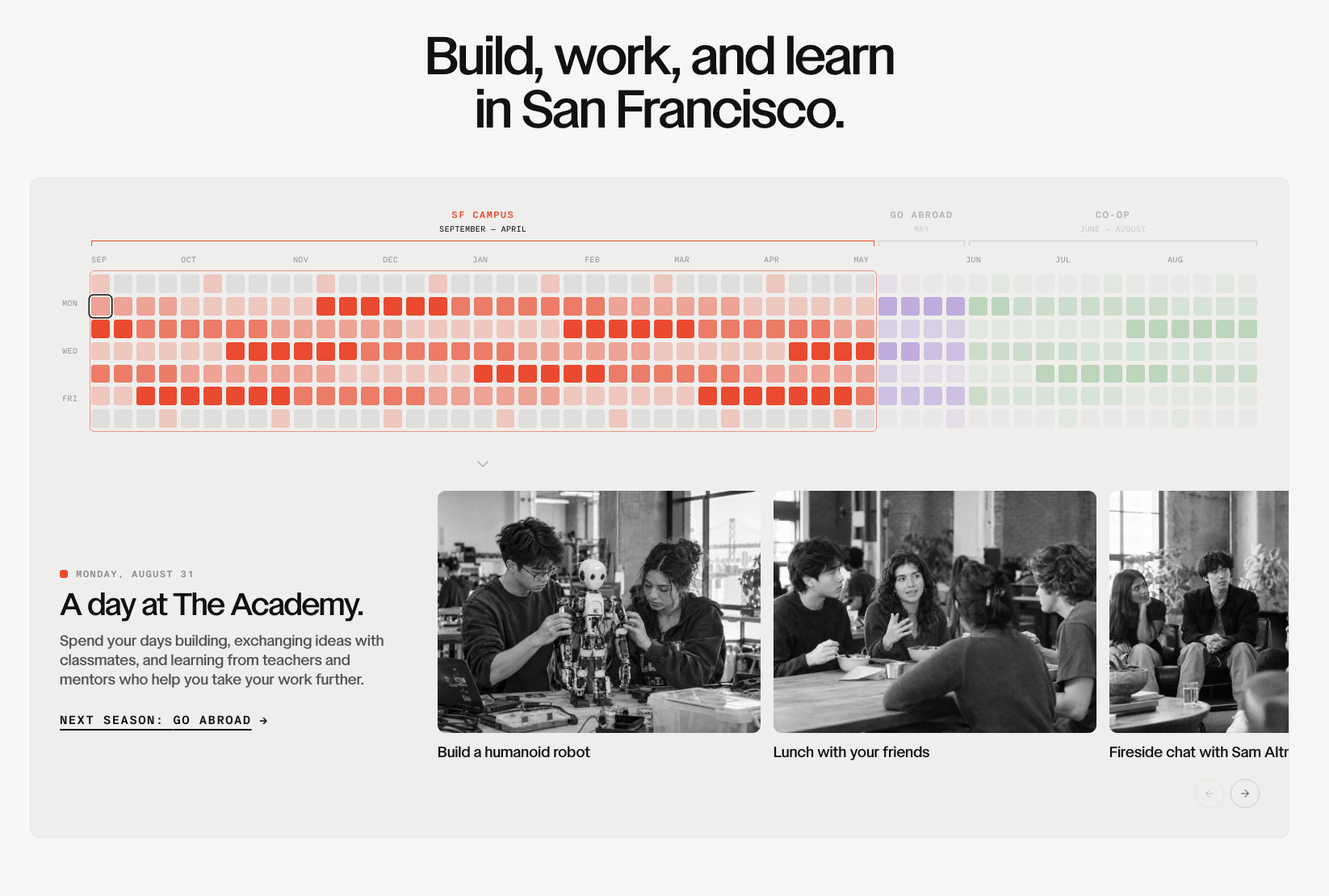
The first offering is the Founding Class Fellowship, a one-year program that starts in September 2027. There are no traditional grades, tests or homework. Students spend most of their time on their own projects, take short practitioner-led courses and work inside technology companies through co-op placements.
The Academy is a for-profit education company and is legally separate from the venture firm. a16z incubated it and is investing $35 million of the $42 million raised, and the firm describes the Academy as a long-term investment in the next generation of builders.
Who Is Behind the Academy?
The Academy is led by founder and CEO Gagan Biyani, who co-founded the online learning platform Udemy and the cohort-based course company Maven. In his launch post on the a16z newsletter, Biyani describes the Academy as the next step in nearly 20 years of work on how people learn.
Marc Andreessen and a16z general partner Erik Torenberg are joining the board. The round was led by a16z, with angel investors including Adam D'Angelo of Quora, Tobi Lütke of Shopify, Tony Xu of DoorDash, Fidji Simo, Garry Tan of Y Combinator, Joe Liemandt of Alpha School and Shyam Sankar of Palantir.
Speaking to Fortune, Biyani framed the project as a business opportunity inside a $2 trillion higher education market. He also said the school does not reject higher education, telling the outlet "we believe in college." His argument is that a small group of unusually driven 18-year-olds will learn more by building alongside operators than in a traditional classroom.
How the Program Works
The educational model rests on three parts, which the Academy calls Pursuits, Courses and Co-ops.
- Pursuits are self-directed projects that students choose themselves, such as a startup idea, a research question, a robot or a film. They are the core of the program, and the Academy says it will help fund related travel and make introductions when a project takes a student abroad.
- Courses run from two days to four weeks and are taught by founders and operators. Topics listed by the Academy include founder-led sales, B2B go-to-market, storytelling and new media, company culture, and startup mechanics such as company formation, cap tables, finance and fundraising.
- Co-ops are integrated internships at technology companies, where students work with real teams and build a track record before they graduate.
The year follows a set rhythm. Students are on the San Francisco campus from September to April, travel abroad in May and spend June through August in co-op placements.
Coding experience is not required, and the Academy says it welcomes designers, researchers, community builders and creators as well as engineers.
Founding Partners, Faculty and Hiring Partners
The Academy launched with ten founding partners: Anduril, Anthropic, Coinbase, Google, Meta, NVIDIA, OpenAI, Palantir, Replit and Stripe. Depending on the company, they will provide compute and hardware, help shape the curriculum and offer hands-on learning and co-op opportunities.
More than 40 additional companies have signed on as hiring partners, including Databricks, Cognition, Boom Supersonic, Applied Intuition, Etched and Clay. The a16z portfolio alone lists more than 19,000 open roles across 850 companies, which gives students a large pool of potential placements.
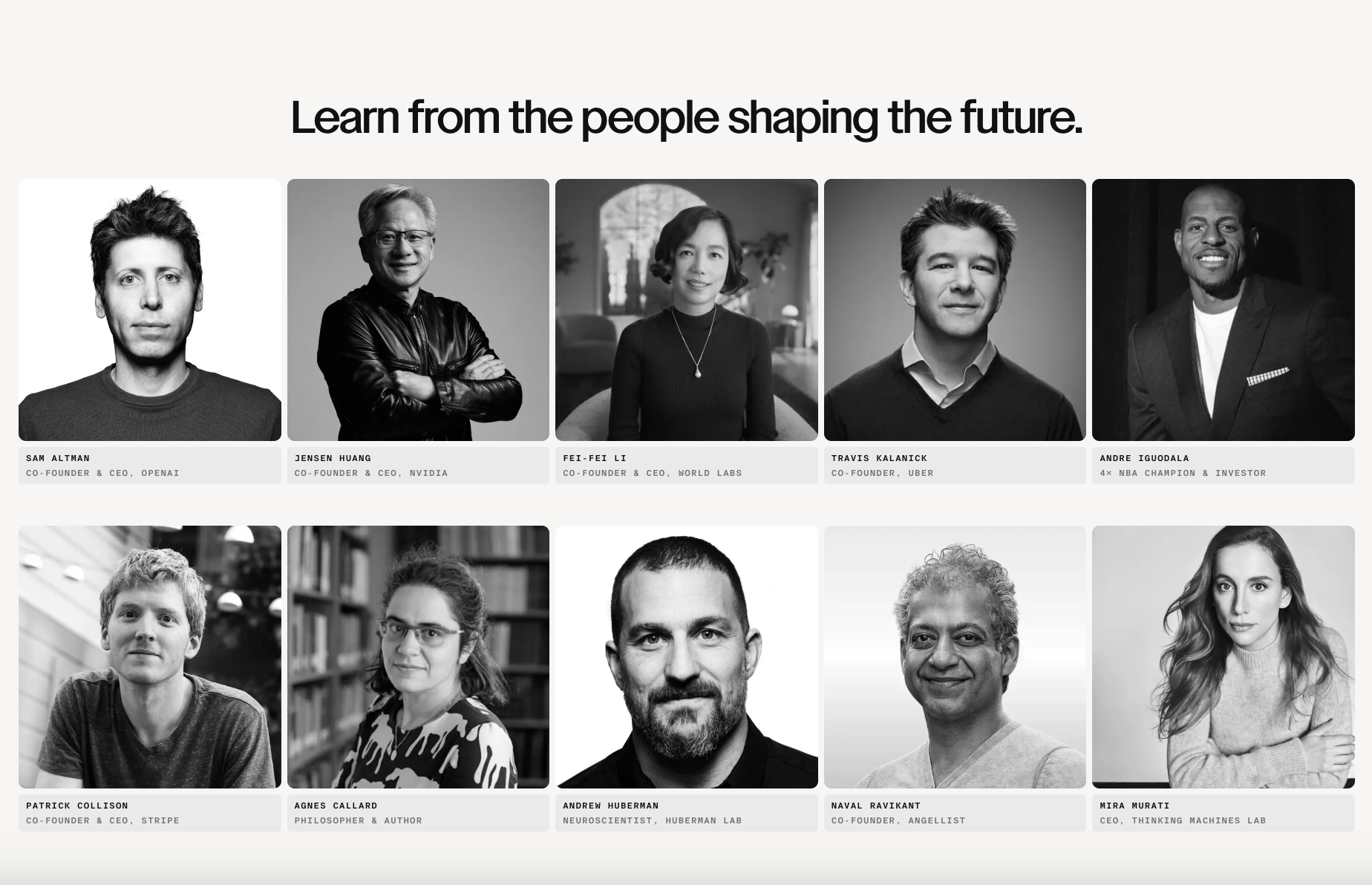
The speaker and mentor network runs to more than 200 names. Sam Altman, Brian Armstrong, Dylan Field, Amjad Masad, Naval Ravikant and Marc Andreessen are named as faculty and guest speakers, and the Academy's website also features Jensen Huang, Patrick Collison, Satya Nadella, Fei-Fei Li, Mira Murati and economist Tyler Cowen among the people students will learn from.
What Does the Horowitz Andreessen Academy Cost?
The Founding Class Fellowship is tuition-free. Each fellow also receives more than $50,000 in compute credits and a $5,000 travel and research budget.
Students do pay for their own housing, food and living costs. The Academy says it has found dorm providers in San Francisco charging roughly $1,600 to $1,800 per month for shared rooms and $2,300 to $2,600 per month for single rooms, and need-based grants for living expenses may be available.
The bigger number comes later. The Academy plans to seek regulatory approval for a two-year program starting in Fall 2028, and Biyani told Fortune it would cost something similar to elite private universities, in the range of $60,000 to $90,000 per year. That program is not yet approved or enrolling students.
The Fellowship does not participate in federal or state financial aid programs, and 529 college savings funds cannot be used tax-free.
Who Can Apply and Key Deadlines
The admissions page says the Academy is looking for applicants who already act on their ideas. Applicants need a high school diploma or equivalent by August 2027 and cannot have completed more than one year of full-time college by that date.
Priority goes to graduating high school seniors, international students are welcome, and there is no minimum age, although applicants under 18 need a parent or guardian to co-sign.
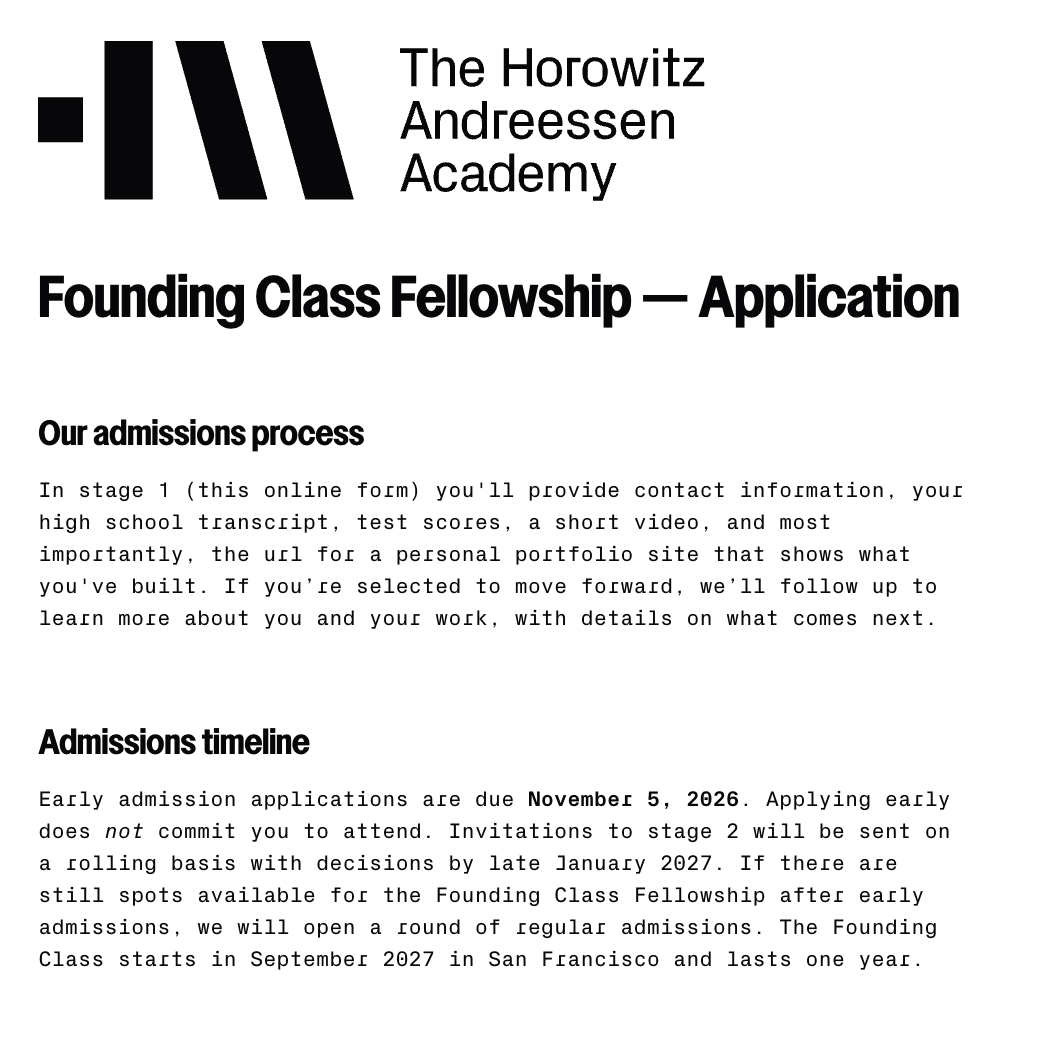
Admission is weighted heavily on proof of work. Stage 1 asks for contact details, a portfolio website showing what you have built, a short video, test scores and a high school transcript. There are no essays or recommendation letters at this stage.
- November 5, 2026: early application deadline (applying early does not commit you to attend)
- Late January 2027: early admissions decisions
- January 15, 2027: regular admissions deadline, with rolling review afterwards if places remain
- September 2027: Founding Class Fellowship begins in San Francisco
Some of the early applicants featured on the site have already raised $100,000 for an enzyme engineering startup, built an AI book indexer with six-figure annual revenue and grown a nonprofit to more than 300 chapters, which gives a sense of the bar.
What Students Leave With
The Academy is not accredited, and the Fellowship awards neither a degree nor college credit. Students instead graduate with a portfolio of work, a network of mentors and companies, and co-op experience that the Academy expects will lead either to a new company or a role on a fast-growing team.
Students keep full ownership of what they build. The Academy takes no equity, no income share and no right of first refusal on student companies, and a16z has no special claim on them either, though the Academy says it will happily make investor introductions.
Co-op placements and jobs are not guaranteed, and the Academy notes that while most Silicon Valley co-ops are paid, it cannot promise that every placement will be.
The Open Questions
Critics have focused on the gap between the free first year and the planned price tag. Dealroom's coverage summed it up as an unaccredited academy aiming for Harvard-level prices without offering degrees, and Fortune reported that experts are skeptical about how the model scales and how students will pay without federal aid.
There is also the question of fit. The Academy itself says college remains a good option for most students and that it is built for a small group who already know how to build. Families weighing it as a gap year should check whether their accepted college allows deferral, since that decision sits with each university.
On the other side, the Academy offers something most universities cannot, which is daily proximity to the companies and operators shaping AI. Erik Torenberg has argued that talented students who skip college often lose the tight peer group where future co-founders meet, and the Academy is designed to give them that community without the four-year detour.
Why It Matters for Founders and Investors
The Academy fits a wider pattern of a16z building its own talent and company pipeline, alongside moves such as the a16z Machine Age Fund for AI hardware. By investing in 18-year-old builders before they have a company, the firm gets early relationships with the next generation of founders and gives its portfolio companies a new source of AI-native talent.
For founders hiring early employees, the Academy's co-op model could become a useful recruiting channel from 2028 onwards. For investors, it is worth watching as a test of whether a network and a portfolio can compete with a degree as a credential.
FAQs
Is the Horowitz Andreessen Academy free?
The Founding Class Fellowship starting in September 2027 is tuition-free and includes $50,000 or more in compute credits and a $5,000 travel budget. Students pay their own housing and living costs. A future two-year program, if approved, is expected to cost $60,000 to $90,000 per year.
Does the Horowitz Andreessen Academy give a degree?
No. The Academy is not accredited and does not award a degree or college credit. Students leave with a portfolio, a network and co-op experience.
Who runs the Horowitz Andreessen Academy?
Gagan Biyani, co-founder of Udemy and Maven, is founder and CEO. Marc Andreessen and Erik Torenberg sit on the board.
How many students will the Academy accept?
The founding class is expected to include around 50 students. An a16z spokesperson told TechCrunch that the school may grow beyond that in the future.
When is the application deadline?
Early applications close on November 5, 2026, and regular applications close on January 15, 2027. Applications are submitted through the Academy's website.
Can international students apply?
Yes. U.S. citizenship or residency is not required, although the Academy cannot guarantee visa approval and offers guidance on the process.
Does a16z take equity in student startups?
No. Students own 100% of what they build, and neither the Academy nor a16z takes equity, an income share or a right of first refusal.
If you are building something and want to know which investors are actively writing first checks, the Everything Startups New VC Funds Database tracks newly announced funds every week, with check sizes, focus areas and contact details for each firm.